
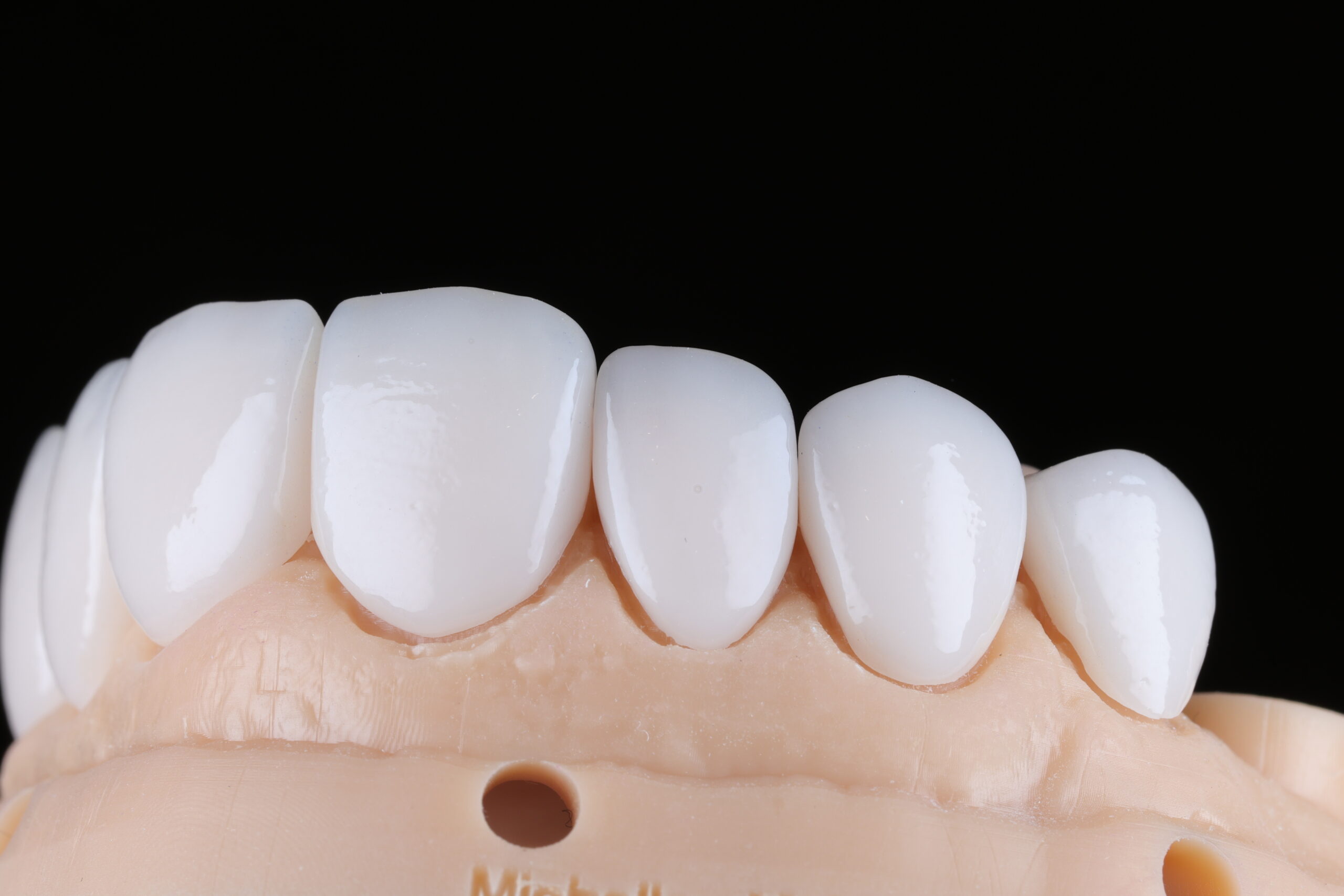

The veneer decision is really three decisions stacked together: which material, how much preparation, and how long it needs to last. Porcelain veneers — whether hand-layered feldspathic or milled lithium disilicate — give the best aesthetics and the strongest longevity data, while direct composite is faster, more conservative and more repairable but wears and stains sooner. This guide compares the three families on the evidence, on preparation, and on the practical points that decide which one belongs in a given case.
The three veneer families
Feldspathic porcelain is the hand-built, stacked-ceramic veneer — the most controllable aesthetically because the technician layers translucency and characterisation directly. It can be made extremely thin, which makes it the classic choice for additive, minimal- or no-preparation cases in skilled hands.
Milled Lithium Disilicate (e.max and equivalents) is a stronger glass-ceramic, pressed or milled to shape. It trades a little of feldspathic’s layering artistry for higher strength and predictability, and it remains fully bondable.
Direct composite is placed and cured chairside in a single visit, with no lab stage. It is the most conservative and the only genuinely reversible option, but it is a resin — softer, more porous, and shorter-lived than ceramic.
What the survival data actually shows
The headline is that porcelain veneers last, and the two porcelain types are closer than many expect. A systematic review and meta-analysis of ceramic laminate veneers reported ten-year survival of 96.13% for feldspathic and 96.81% for lithium disilicate — effectively no difference in survival between them.¹ A separate systematic review of porcelain laminate veneers put survival at up to around 95% at ten years, tapering to roughly 85% at fifteen years.²
These figures relate to lithium disilicate as a material family and do not necessarily distinguish between every individual fabrication route. The clinical performance of a milled restoration still depends on appropriate preparation, material thickness, milling accuracy, crystallisation, finishing and adhesive bonding.
Where the two porcelains separate is in complications, not survival: the same meta-analysis found feldspathic veneers considerably more prone to technical complications such as chipping and fracture than lithium disilicate.¹ So if a case is high-risk mechanically, milled lithium disilicate provides additional resilience and a more standardised digital manufacturing workflow; where the aesthetic demand is everything and the loading is favourable, feldspathic still earns its place.
Composite sits below both. A systematic review of resin composite laminate veneers reported a higher annual failure rate than ceramic and overall survival in the region of 88–91%, with the material more susceptible to fracture, wear and marginal breakdown over time.³ That does not make composite wrong — it makes it a different tool, best where reversibility, speed or budget lead the decision.
Preparation and reversibility — what patients are really asking
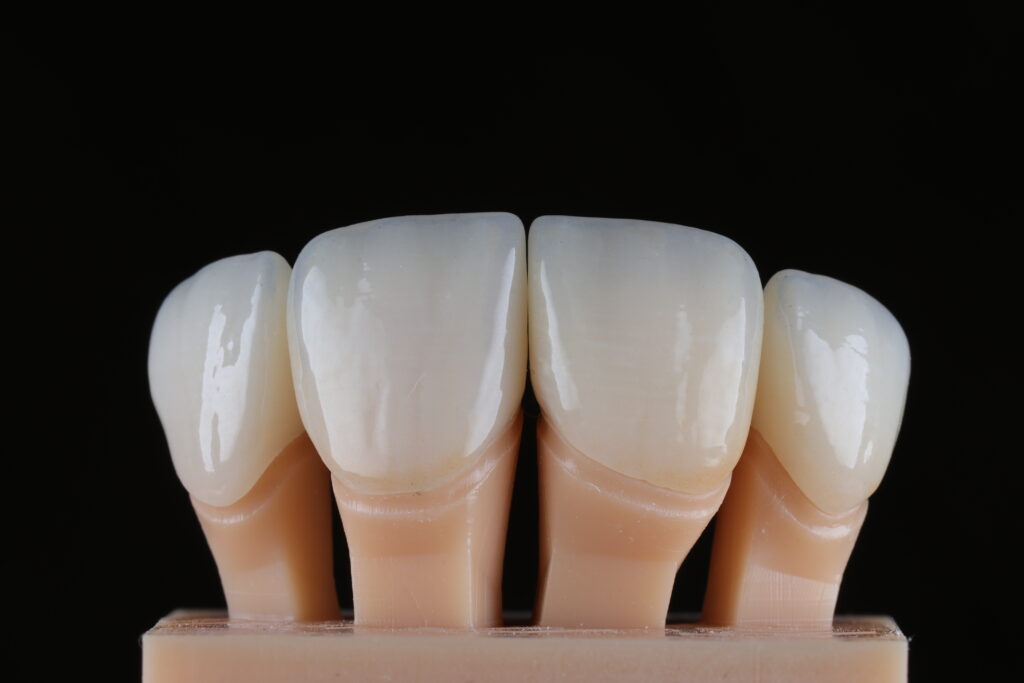
“What happens to the teeth under veneers?” and “are veneers permanent?” are among the most common questions patients bring in, and the honest answer depends entirely on the material and the design. Porcelain veneers usually require a defined, if conservative, enamel reduction to create space and a bondable surface — that reduction is not reversible, so the tooth is committed to a restoration thereafter. Feldspathic in a purely additive case can sometimes be done with little or no preparation, and direct composite is generally the most conservative and the most reversible.
The clinical goal is to stay in enamel wherever possible: bonding to enamel is more durable than bonding to dentine, so a preparation that preserves an enamel margin protects the longevity numbers above. Planning that reduction against the final tooth position — rather than cutting first and hoping — is exactly what a digital smile design and mock-up is for.
For milled lithium disilicate, the preparation also needs to provide sufficient space for the planned ceramic thickness while avoiding sharp internal angles or unsupported areas. The digital design should account for minimum material thickness, insertion path, margins and occlusal loading before the restoration is milled.
The milled lithium disilicate workflow
A milled lithium disilicate veneer generally follows a digital CAD/CAM workflow:
- The preparation and surrounding dentition are captured using an intraoral scan or a scanned laboratory model.
- The veneer is digitally designed with controlled thickness, contacts, margins, emergence profile and occlusal relationship.
- The restoration is milled from a lithium disilicate CAD/CAM block.
- The milled veneer is inspected, fitted and carefully adjusted where required.
- For systems milled in a partially crystallised state, the restoration undergoes a crystallisation firing to achieve its final strength and shade.
- Surface characterisation is completed through staining and glazing, or through cut-back and ceramic layering where greater aesthetic customisation is required.
- The intaglio surface is prepared according to the ceramic manufacturer’s bonding protocol before adhesive cementation.
Careful finishing matters. Any adjusted ceramic surfaces should be appropriately polished or reglazed, and the internal surface treatment must follow the specific lithium disilicate system being used.
Staining and maintenance
This is a real material difference, not a marketing one. Composite is a resin and more porous, so it picks up stain from coffee, tea, red wine and tobacco and needs polishing and occasional refurbishment to hold its shade.³ Glazed porcelain is far more stain-resistant and holds its colour over years. For a patient who wants a result that stays put with minimal upkeep, porcelain is the more predictable long-term answer; for one who wants a quick, adjustable change and accepts the maintenance, composite is reasonable.
Choosing the material: a working framework
Maximum aesthetics, favourable loading → feldspathic porcelain, ideally minimal-prep.
Aesthetics plus mechanical resilience and a predictable digital workflow → milled lithium disilicate.
Conservative, reversible, single-visit, budget-led → direct composite, accepting shorter service life and more maintenance.
Enamel available to bond to → strongly favours any bonded porcelain option and protects longevity.
Most “which veneer is best” debates resolve once the case is framed by aesthetics, loading, how much enamel you can keep, and how long the patient needs it to last.
How Zenith crafts your veneer cases
Zenith’s veneer work is built around high-translucency feldspathic porcelain and milled lithium disilicate, with digital smile design and try-in options so the case is agreed before it is finalised — the founder is a practising dentist, so the aesthetic conversation happens peer-to-peer rather than being left to guesswork.
For milled lithium disilicate cases, the restoration is digitally designed to control ceramic thickness, margins, contacts and final tooth form before being milled. It is then fitted, crystallised where required, and finished through staining, glazing or aesthetic layering according to the demands of the case.
We design from your intraoral scan, return a digital design preview within 24–48 hours, and hold a 2% remake rate against an 8–12% industry average — which on a matched anterior veneer case is the difference between one seating appointment and several. You can see how we approach aesthetic and cosmetic cases, and we accept scans from 3Shape, iTero, Medit, DS Core, Carestream and Smilecloud.
If you have an anterior case where the material or the preparation isn’t obvious, send it through and we’ll plan it with you.
FAQs
Frequently asked questions
Everything you need to know about working with Zenith Labs.
What are veneers made of?
Veneers are made from one of three materials: feldspathic porcelain (hand-layered ceramic), pressed lithium disilicate (a stronger glass-ceramic such as e.max), or direct composite resin placed chairside. Porcelain types are lab-made and bonded; composite is built up on the tooth in a single visit.
How long do porcelain vs composite veneers last?
Porcelain veneers have strong long-term data — around 96% survival at ten years for both feldspathic and lithium disilicate, and roughly 85% at fifteen years.¹² Composite veneers are shorter-lived, with a higher annual failure rate and survival in the region of 88–91%, and they typically need refurbishment sooner.³
Composite or porcelain veneers — which is better?
Neither is universally better. Porcelain (feldspathic or pressed) gives superior aesthetics, stain resistance and longevity but requires a lab stage and some irreversible preparation. Composite is faster, cheaper, more conservative and reversible, but wears and stains sooner. The case — aesthetics, loading, budget and reversibility — decides.
How are milled lithium disilicate veneers made?
They are digitally designed from an intraoral scan or laboratory scan and milled from a CAD/CAM lithium disilicate block. Depending on the material system, the restoration may then undergo crystallisation firing before being stained, glazed or layered. It is finally prepared for adhesive bonding according to the manufacturer’s protocol.
What happens to the teeth under veneers — are they reversible?
It depends on preparation. Porcelain veneers usually need a conservative but irreversible enamel reduction, so the tooth is committed to a restoration afterwards. Minimal- or no-prep feldspathic and direct composite can be far more conservative, and composite is generally reversible. Keeping the margin in enamel improves the bond and the longevity.
Do veneers stain?
Porcelain veneers are highly stain-resistant and hold their colour for years. Composite veneers are more porous and do pick up stain from coffee, tea, red wine and tobacco over time, needing periodic polishing.³ Note that veneers do not respond to whitening, so shade is set at the design stage.
Sources
- PMC — “Survival and Complication Rates of Feldspathic, Leucite-Reinforced, Lithium Disilicate and Zirconia Ceramic Laminate Veneers: A Systematic Review and Meta-Analysis” — https://pmc.ncbi.nlm.nih.gov/articles/PMC12076113/
- PMC — “Survival Rates for Porcelain Laminate Veneers: A Systematic Review” — https://pmc.ncbi.nlm.nih.gov/articles/PMC8184312/
- ScienceDirect, Journal of Dentistry — “Survival and Complication Rates of Resin Composite Laminate Veneers: A Systematic Review and Meta-Analysis” — https://www.sciencedirect.com/science/article/abs/pii/S1532338223001033