
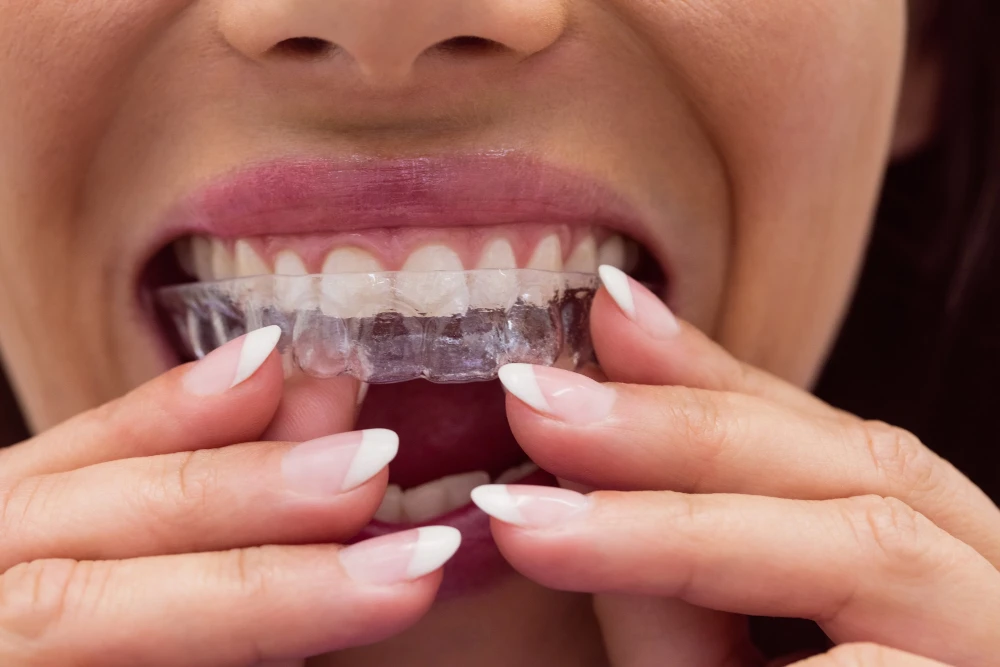

Dental splints are used to stabilise teeth when mobility, trauma or occlusal factors make controlled support clinically appropriate. The three main categories are periodontal splints, used primarily to stabilise mobile periodontally compromised teeth; occlusal splints, used in the management of bruxism and selected TMD/occlusal presentations; and trauma splints, used for short-term stabilisation following dental injuries.¹²³
What is a dental splint?
A dental splint joins two or more teeth, or otherwise stabilises an injured tooth, so that functional forces are distributed across a more stable unit. The clinical objective differs according to the indication: periodontal splinting is principally about managing mobility and maintaining function, whereas trauma splinting supports healing after injury.¹⁴
In practice, tooth splinting is not a substitute for treating the underlying disease or injury. For periodontally compromised teeth, the splint should be considered an adjunct to periodontal treatment and supportive periodontal therapy (SPT), rather than a treatment that alters the underlying periodontal prognosis.²³
Periodontal splints
A periodontal splint is most commonly considered when tooth mobility associated with periodontal attachment and bone loss is causing functional discomfort or compromising the patient’s ability to function comfortably. Splinting can mechanically stabilise mobile teeth by sharing functional loads with adjacent teeth.¹⁴
Typical situations include:
- Persistent mobility causing functional discomfort, where stabilisation improves comfort and function.¹⁴
- Selected cases requiring longer-term maintenance of compromised teeth, provided the teeth remain restorable and the splint can be kept adequately clean.¹³
- A missing anterior tooth combined with adjacent mobility, where a splint incorporating a pontic may provide a provisional fixed replacement while definitive treatment is considered.¹
The important distinction is between symptom and prognosis. Periodontal splinting can reduce mobility and improve comfort and function, and it may help clinicians retain periodontally compromised teeth during maintenance. It should not, however, be presented as improving the periodontal prognosis. A systematic review concluded, on low-quality evidence, that tooth splinting does not improve survival of mobile teeth in advanced periodontitis.⁵
Longitudinal studies nevertheless show that splinted teeth can remain functional for substantial periods when patients are receiving supportive periodontal care. In one retrospective study of splinted anterior mandibular teeth under SPT, the reported splint survival rate before fracture or debonding was 74.4% at three years.² Another long-term study found no significantly increased risk of tooth loss for splinted teeth compared with non-splinted teeth, while also reporting that 75.3% of splints required repair during follow-up; the authors specifically concluded that splinting does not improve periodontal prognosis but can assist retention by reducing mobility.³
That distinction is particularly relevant when discussing long-term treatment planning with patients: splint longevity and tooth prognosis are separate clinical questions.
Materials for periodontal splinting
Direct periodontal splints are commonly constructed using composite resin, either alone or reinforced with fibres. Fibre-reinforced composite (FRC) techniques are widely used for anterior stabilisation because they allow a relatively conservative, tooth-coloured approach.¹⁴
Two broad reinforcement options are glass fibres and polyethylene fibres such as Ribbond. Comparative evidence does not establish a simple clinical winner between the two: a review of glass and polyethylene fibre-reinforced composites reported that both approaches reduced tooth mobility and were considered aesthetically acceptable, with no significant difference in adhesion failure or patient comfort over the short follow-up studied.⁶ Material selection is therefore better considered alongside handling characteristics, adaptation, fibre positioning, composite integration, occlusion and, critically, cleansability.⁴⁶
A periodontal splint should not be designed simply for maximum rigidity. The clinical aim is controlled stabilisation while preserving periodontal access and avoiding unnecessary bulk.
Maintenance of periodontal splints
Maintenance is part of the treatment, not an afterthought. Splinted teeth need to remain accessible for periodontal assessment and professional debridement, while the splint itself should be checked for debonding, fracture, wear, excess composite and plaque-retentive areas.¹³
The long-term data are instructive: in the study by Graetz et al., 75.3% of splints required repair, with a mean of 2.6 repairs per splint over the observation period,³ and a separate study of splinted anterior mandibular teeth reported 74.4% splint survival at three years before fracture or debonding.² This makes design clinically important — a splint that is technically successful on the day of placement but difficult to clean creates avoidable maintenance problems. Consider access for interdental cleaning, periodontal probing and instrumentation before finalising the design.
Occlusal splints
Occlusal splints are a separate clinical category from periodontal splinting, used in selected cases involving bruxism, occlusal management and TMD-related presentations. The prescription, design and adjustment depend on the diagnosis and intended therapeutic objective, and they should not be conflated with splints placed to stabilise periodontally mobile teeth. For a detailed discussion, see our occlusal splints guide. Where digital occlusal assessment is relevant to case planning, clinicians can also review MODJaw digital occlusion analysis.
Trauma splints
Trauma splints stabilise teeth or alveolar segments following injuries such as luxation, avulsion or root fracture. Unlike many periodontal splints, the contemporary trauma approach generally favours a passive, flexible splint for a defined, short period, allowing controlled physiological movement during healing.⁷⁸
The appropriate duration depends on the injury. IADT guidance generally supports short-term, passive and flexible splinting — for example, around two weeks for selected subluxation cases and approximately four weeks for several luxation and root-fracture injuries — with duration determined by the specific injury rather than clinician preference.⁷⁸
Which splint for which case?
| Clinical situation | Splint type | Primary purpose |
|---|---|---|
| Periodontally compromised tooth with persistent mobility and functional discomfort | Periodontal splint | Reduce mobility and improve comfort/function as an adjunct to periodontal maintenance |
| Periodontally compromised anterior teeth requiring longer-term stabilisation | Periodontal splint | Support retention and function where teeth remain maintainable |
| Bruxism, selected occlusal indications or TMD-related management | Occlusal splint | Occlusal management according to the specific diagnosis |
| Luxation, avulsion or selected root/alveolar fractures | Trauma splint | Short-term stabilisation during healing |
| Mobile teeth plus a missing anterior tooth requiring a provisional replacement | Periodontal splint with pontic | Stabilisation with provisional tooth replacement in selected cases¹ |
The key prescribing question is therefore not simply “Does this tooth move?” It is “Why is the tooth mobile, what is the treatment objective, and does stabilisation serve the wider plan for periodontal control and SPT?”³⁵
How Zenith supports splint cases
Zenith Dental Labs is a dentist-founded, UK-based digital dental laboratory supporting clinicians with digital workflows. Our own splint product is the lab-made occlusal splint; periodontal and trauma splints are chairside procedures and are not fabricated by Zenith.
For cases requiring laboratory support, we provide a 24–48-hour digital design preview and accept scans from 3Shape, iTero, Medit, DS Core, Carestream and Smilecloud, and we hold a 2% remake rate against an 8–12% industry average. See the wider range of our digital laboratory services. If you have a case where the distinction between periodontal, trauma and occlusal splinting affects the workflow, or you need laboratory support for an occlusal splint, get in touch or submit a case.
FAQs
Frequently asked questions
Everything you need to know about working with Zenith Labs.
What is a dental splint?
A dental splint is a device or bonded construction used to stabilize teeth by linking them together or supporting an injured tooth. Its purpose varies with the indication — periodontal mobility, occlusal management or dental trauma.¹⁷
What is dental splinting?
Dental splinting is the clinical process of stabilizing one or more teeth, commonly by joining mobile teeth with composite and, where indicated, fibre reinforcement. In periodontal cases it is an adjunct to periodontal treatment, not a treatment for the underlying attachment loss.³⁴
What are the three types of dental splint?
Periodontal splints, occlusal splints and trauma splints. Their indications and expected duration differ substantially, so the splint should be selected according to the underlying diagnosis and treatment objective.¹⁷
When is a periodontal splint prescribed?
When tooth mobility from periodontal attachment and bone loss causes functional discomfort, or where longer-term stabilization supports retention of maintainable teeth — always as an adjunct to periodontal therapy, not as a way to improve prognosis.³⁵
What materials are used for periodontal splinting?
Direct periodontal splints are commonly made with composite resin, with or without fibre reinforcement. Glass fibres and polyethylene fibres such as Ribbonds are both used; current comparative evidence does not show one is universally superior.¹⁶
How long should a trauma splint stay in place?
There is no single duration for every injury. IADT guidance supports short-term, passive, flexible splinting, with duration set by the injury — for example around two weeks for selected subluxation and about four weeks for several luxation and root-fracture injuries.⁷⁸
Sources
- Golob Deeb J, Carrico CK, Miller A, Bennett J, Ghassemi A. “Maintenance of Periodontally Compromised Teeth Using Periodontal Splints.” International Journal of Dentistry, 2025 — https://onlinelibrary.wiley.com/doi/10.1155/ijod/7119673
- Sonnenschein SK, Betzler C, Rütters MA, Krisam J, Saure D, Kim T-S. “Long-term stability of splinted anterior mandibular teeth during supportive periodontal therapy.” Acta Odontologica Scandinavica, 2017;75(7):475–482 — https://pubmed.ncbi.nlm.nih.gov/28643542/
- Graetz C, Ostermann F, Woeste S, Sälzer S, Dörfer CE, Schwendicke F. “Long-term survival and maintenance efforts of splinted teeth in periodontitis patients.” Journal of Dentistry, 2019;80:49–54 — https://pubmed.ncbi.nlm.nih.gov/30389428/
- “Fibre-Reinforced Composite Splint – Step-by-Step Instructions.” Dental Update — https://www.dental-update.co.uk/content/restorative-dentistry/fibre-reinforced-composite-splint-step-by-step-instructions
- Dommisch H, et al. “Efficacy of tooth splinting and occlusal adjustment in patients with periodontitis exhibiting masticatory dysfunction: A systematic review.” Journal of Clinical Periodontology — https://pubmed.ncbi.nlm.nih.gov/34854115/
- “Comparative evaluation between glass and polyethylene fiber-reinforced composites: A review of the current literature.” — https://pmc.ncbi.nlm.nih.gov/articles/PMC5794118/
- Bourguignon C, et al. “International Association of Dental Traumatology guidelines for the management of traumatic dental injuries: 1. Fractures and luxations.” Dental Traumatology, 2020 — https://doi.org/10.1111/edt.12578
- Fouad AF, et al. “International Association of Dental Traumatology guidelines for the management of traumatic dental injuries: 2. Avulsion of permanent teeth.” Dental Traumatology, 2020 — https://doi.org/10.1111/edt.12573