
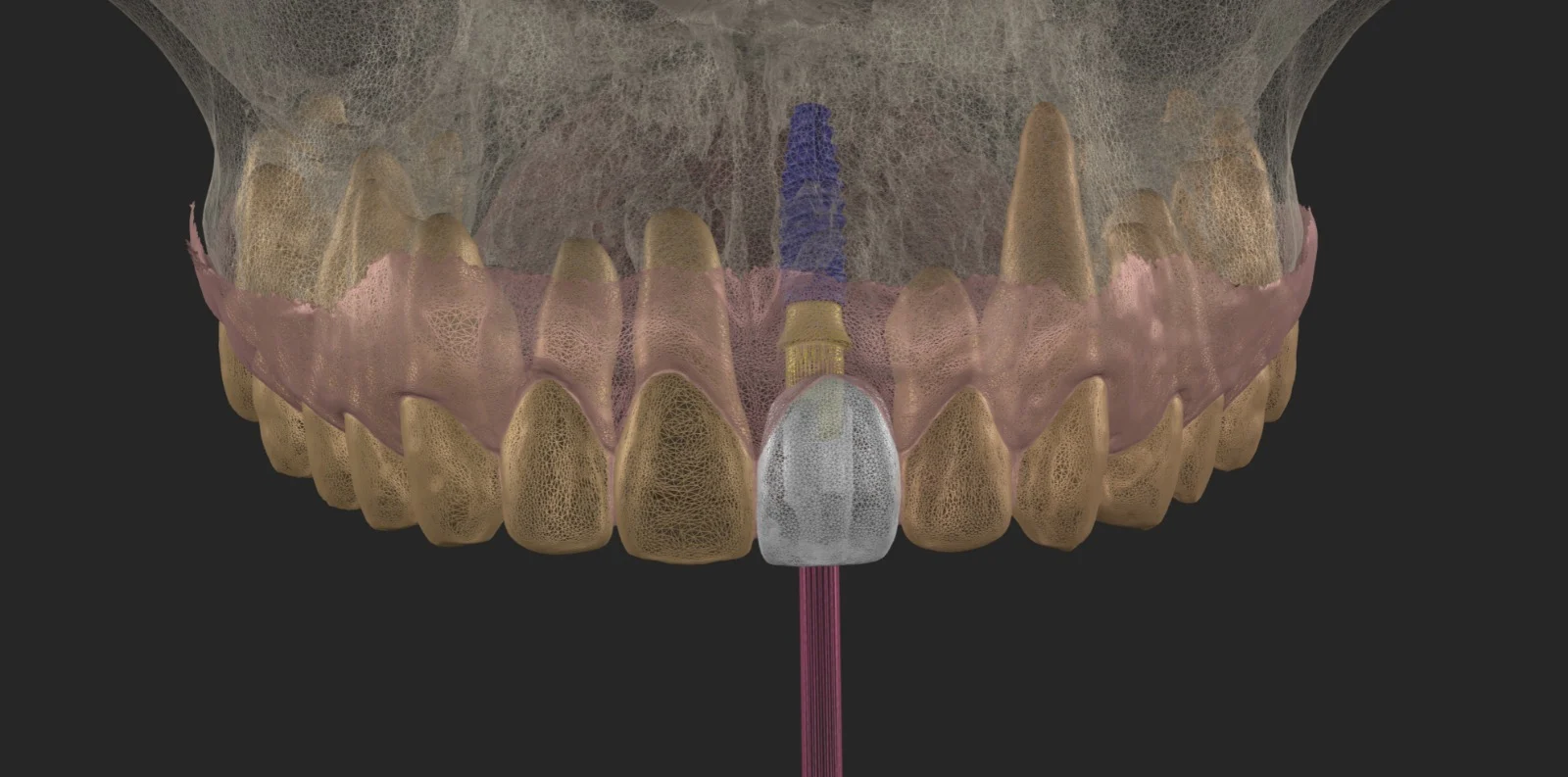

Dental implant surgery has evolved dramatically over the past decade. What was once primarily a manual procedure is now guided by digital planning, 3D imaging, and precision-engineered surgical guides that significantly improve clinical predictability, surgical accuracy, and restorative outcomes. Guided implant workflows ensure that prosthetic and surgical phases are united from the outset, whether for a single tooth implant or complex full-arch rehabilitation, a difference that directly affects functional stability, aesthetics, long-term success, and patient satisfaction.
At Zenith Dental Labs, we offer a high-standard service in digital implant planning and surgical guide fabrication, supporting clinicians with solutions tailored to their clinical preferences, case complexity, and desired protocols, including immediate loading temporaries or conventional healing sequences.
From Scan to Surgery: What Is Digital Implant Planning?
Digital implant planning uses 3D radiographic data – typically CBCT scans – merged with intraoral scans or digital impressions. This integrated dataset allows clinicians and labs to visualise patient anatomy in three dimensions, identify critical structures such as nerves and sinus anatomy, and plan implant positions that are prosthetically driven and surgically precise. The digital plan is then used to design a surgical guide that transfers the virtual plan accurately into the clinical environment, ensuring optimal angulation, depth, and positioning during osteotomy and implant insertion.
The Value of Guided Surgery Over Free-Hand Implant Placement
While traditional free-hand implant placement can be effective, it relies heavily on clinical experience and intraoperative judgment. Digital implant planning and surgical guides elevate this process by:
- Increasing surgical accuracy, reducing deviation from planned implant position.
- Guiding depth and angulation exactly according to the prosthetic plan.
- Reducing clinical risk, including avoiding vital anatomical structures.
- Improving patient outcomes by enabling more predictable long-term stability and restorative success.
This approach benefits both clinician and patient by decreasing operative time, improving confidence in implant position, and enabling a more predictable restorative phase.
SMOP by Swissmeda: A Trusted Planning Framework
One of the advanced systems utilised by Zenith Dental Labs is SMOP by Swissmeda, a cloud-integrated implant planning platform designed for teams of clinicians and technicians to collaborate efficiently. SMOP enables full digital planning directly from CBCT data without requiring upfront software installation or complex IT infrastructure.
Key advantages of SMOP include:
- Highly precise drilling templates generated from 3D implant planning data, tailored to patient anatomy.
- Open, cloud-based workflow that supports case submission, review, and approval from anywhere.
- Intuitive planning and communication tools enabling aligned decision-making between dentist, surgeon, and dental laboratory.
- Improved intraoperative visibility and irrigation thanks to patented open surgical guide designs.
These features allow Zenith to develop surgical guides that are precisely aligned with both the bone anatomy and the planned prosthetic outcome, whether for a single unit implant or a multi-implant full-arch strategy.
Stackable Surgical Guides: A Multi-Step Approach
For cases requiring sequential phases, such as bone reduction, implant placement, and provisionals, particularly in full-arch or immediate loading scenarios, stackable surgical guide systems provide exceptional control and precision.
A stackable guide system breaks the surgery into modular, interlocking components that each support a distinct step, such as:
- Pin Positioning Guide (PPG) for stable guide fixation
- Bone Reduction Guide (BRG) to precisely shape the ridge for prosthetic and implant requirements
- Implant Surgical Guide (ISG) for osteotomy and implant placement
- Provisional or Temporary Guide for immediate prosthesis positioning (when immediate loading is planned)
Stackable guides are especially valuable in complex full-arch or edentulous cases where multiple implants must be placed with exacting precision, and where initial bone contours or anatomical variations present challenges. This system significantly reduces cumulative error across surgical steps, enhances workflow efficiency, and supports predictable outcomes even when immediate temporary prosthetics are part of the plan.
STARconcept™-Inspired Workflow for Full-Arch Rehabilitation
For full-arch treatments, whether FP1, FP2, or FP3 configurations, guided implant surgery is foundational for reproducibility and prosthetic success. The Straumann® STARconcept™ is an example of an end-to-end regimen that integrates digital planning, smile design, surgical guides, and immediate prosthetic workflows. Although not the only method, it illustrates the value of a fully integrated digital ecosystem for complex cases. The intent is to preserve bone and soft-tissue contours, plan restorative and surgical phases together, and support immediate or early temporaries where clinically appropriate.
At Zenith, we adopt similar principles: merging surgical planning with prosthetic goals, whether immediate loading is indicated or a traditional staged approach is preferred. Prosthetically-driven planning ensures that implant positions serve final restorations, enhancing functional stability and aesthetic outcomes.
Single Tooth Implant Planning: Precision Matters
For a single tooth implant, precision is equally critical. Accurate implant positioning ensures:
- Ideal emergence profile
- Optimal support for the final crown
- Avoidance of neighbouring roots and critical anatomy
- Minimal soft-tissue trauma and improved periodontal health
Digital implant planning with SMOP or an equivalent guided design provides this accuracy and confidence. Surgical guides transfer the virtual plan to the surgical field, significantly reducing the risk of misplacement and improving restoration fit.
Immediate vs. Conventional Loading: What Zenith Offers
Whether your clinical protocol favours immediate loading (with a temporary restoration placed at surgery) or conventional healing, Zenith accommodates both approaches through meticulous digital planning.
Immediate loading cases benefit from:
- Stackable guide workflows that align provisional prostheses with implant positions
- Prosthetically-driven planning that ensures immediate functional and aesthetic outcomes
- Reduced patient visits and enhanced satisfaction
For cases where traditional healing is preferred, our digital planning ensures that implant sites are optimally positioned to support future restorations with maximum stability and structural integrity.
Why Choose Zenith for Digital Implant Planning and Surgical Guides
Zenith Dental Labs delivers this suite of services with a commitment to:
- High quality and reliability in planning and guide fabrication
- Prosthetically driven design logic, ensuring the restorative outcome governs surgical positioning
- State-of-the-art digital workflows supported by cloud systems and 3D guide manufacturing
- Collaborative case management, bridging dental practice, surgeon, and laboratory expertise
Our clinicians benefit from streamlined communication, predictable surgical outcomes, and restorative success that aligns with modern implantology standards.
FAQs
Frequently asked questions
Everything you need to know about working with Zenith Labs.
What is digital implant planning and why is it important?
Digital implant planning uses 3D data to determine implant position, angulation, and depth based on the prosthetic needs. It improves surgical accuracy and reduces unexpected clinical outcomes.
How does a surgical guide improve implant surgery?
Surgical guides transfer the virtual plan into the surgical field, ensuring precise placement that aligns with restorative goals and anatomical considerations.
What are stackable surgical guides?
Stackable systems are modular multi-component guides that support sequential surgical steps, such as bone reduction, implant placement, and provisional delivery, improving accuracy and efficiency.
Can Zenith support immediate loading provisional protocols?
Yes. Zenith’s digital implant planning and guide workflows support both immediate loading and conventional staged approaches based on clinical indications.
Does guided implant planning benefit full-arch cases?
Absolutely. Full-arch cases often require multiple implants and precise prosthetic alignment; surgical guides and prosthetically driven planning significantly enhance predictability and functional outcomes.