
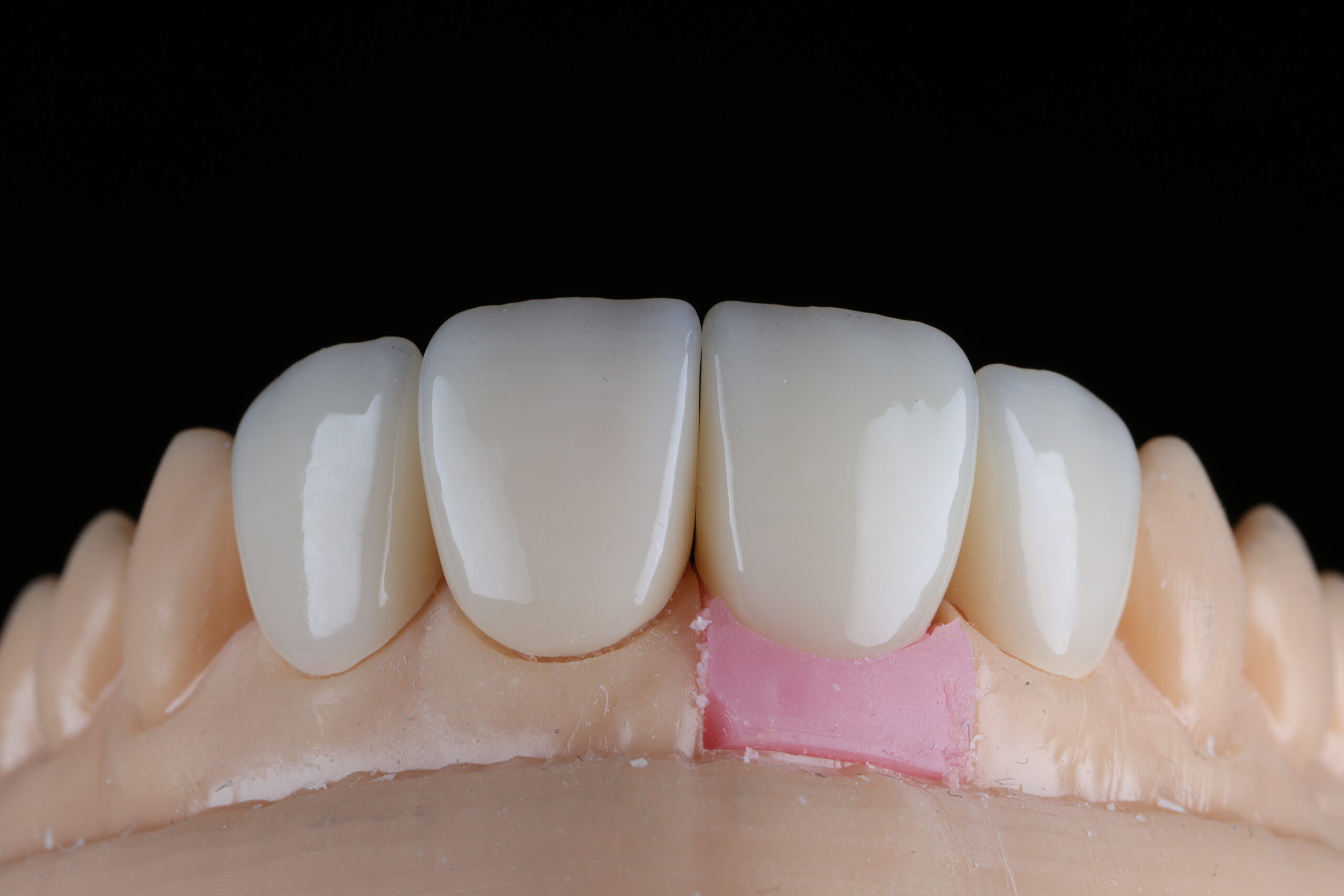

A cobalt-chrome partial denture is a removable prosthesis built on a cast or milled cobalt-chromium alloy framework rather than an all-acrylic base. For most partially dentate patients with sound abutments, a chrome denture is the more conservative long-term choice: the rigidity of the metal lets you design thinner connectors, off-load the soft tissue, and protect the remaining dentition in a way acrylic struggles to match. This guide covers when to prescribe one, how the framework is designed, what the evidence says about longevity, and what your lab needs from you to get the fit right first time.
Why the alloy matters
Cobalt-chromium alloys have been the framework material of choice in removable prosthodontics for decades because of a useful combination of properties: high stiffness and strength, good wear and corrosion resistance, and a stable surface oxide layer formed by a chromium content of roughly 25–30%, which underpins the alloy’s biocompatibility.¹ That rigidity is the clinical point. A metal major connector can be made far thinner than its acrylic equivalent while still resisting flexure under occlusal load, so the prosthesis transmits force more predictably to the abutments and the underlying ridge.
It is worth knowing the regulatory backdrop, because patients and practice managers occasionally ask. Cobalt was reclassified as a CMR (carcinogenic, mutagenic, reprotoxic) substance under the EU framework that applies to dental alloys, which has pushed manufacturers and labs toward tighter handling and documentation rather than away from the material itself.¹ In clinical use, the cast or milled, polished framework remains well tolerated; true cobalt or nickel hypersensitivity is uncommon but should be screened for in the history.
Chrome or acrylic? Making the call
The honest answer is that an acrylic partial is a transitional or interim appliance for most cases, and a cobalt-chrome partial is the definitive one. The difference shows up in three places.
Periodontal protection. Because acrylic is not rigid, it tends to be tissue-borne and gingivally extended, and the literature links acrylic removable partial dentures to more gingival inflammation and a less favourable effect on abutment teeth than metal-framework designs.⁴ A well-surveyed chrome framework can be tooth- and tissue-borne, kept clear of the gingival margins, and designed to distribute load through rests onto sound tooth structure.
Longevity. Metal-based partial dentures simply last longer. A ten-year retrospective analysis of over 1,200 denture-wearing patients reported a median survival of around 73 months for metal-based partials versus about 45 months for acrylic ones.² Survival is design-dependent — one retrospective series of mandibular bilateral free-end saddle cases reported a 93.2% survival rate at ten years³ — but the trend across the evidence favours the metal framework when the goal is a definitive, durable prosthesis.
Fracture and adjustment. Acrylic flexes and fractures; a cast or milled chrome framework does not, which is why a chrome partial holds its designed clasp geometry and occlusal scheme over time. The trade-off is the obvious one — metal display on clasps in the aesthetic zone, and a less straightforward reline/addition path if the dentition changes.
If the patient is likely to lose further teeth in the short term, an acrylic interim denture first is reasonable; once the dentition is stable, move to a definitive cobalt-chrome design.
Designing the framework
A chrome partial is only as good as its design, and that starts at the surveying stage — ideally before you prep anything. The lab needs a clear path of insertion, defined guide planes, identified undercuts for clasp retention, and a rest seat plan that puts load onto enamel or restorations that can take it.
Think through, and communicate, the following on the prescription:
- Kennedy classification and saddle type — tooth-borne versus distal-extension changes the entire support strategy.
- Major connector — lingual bar, lingual plate, or for the maxilla a palatal strap or plate; specify if a torus or shallow sulcus rules an option out.
- Rests and rest seats — occlusal, cingulum or incisal, and whether you will cut the seats or want them planned into restorations.
- Clasp design and aesthetics — RPI or RPA on free-end saddles, where you will accept metal display, and where you want tooth-coloured or rotational-path solutions instead.
- Guide planes and reciprocation — so retention is predictable and not just frictional.
The more of this you decide with the lab up front, the fewer surprises at the framework try-in.
From intraoral scan to chrome framework
Modern removable design is digital, and it removes most of the variability that used to creep in at the impression and cast stages. An accurate full-arch digital impression captured on an intraoral scanner is surveyed in the CAD software, the framework is designed on screen with the rest seats, connectors and clasps you have specified, and it is then produced either by milling or by metal additive manufacturing before finishing and polishing. A digital design step also means you can review and approve the framework before any metal is produced.
This is where working with a digital lab pays off in fit. Zenith was founded by a practising dentist, so the workflow is built around the chairside reality — the dentist-founded approach means design queries are handled clinician-to-clinician, and our digital design preview turns around in 24–48 hours for collaborative approval. Across our restorative work we run a 2% remake rate against an industry average of 8–12%, which on a removable case is the difference between a clean framework try-in and a frustrating one. You can see how we handle digital cases across our lab services, and we accept scans from 3Shape, iTero, Medit, DS Core, Carestream and Smilecloud.
Fit, delivery and recall
A chrome framework should seat passively. If it rocks or needs heavy adjustment, the surveying or the impression is usually the cause — not the metal — which is the strongest argument for getting the digital records right at the start. At delivery, confirm the rests are fully seated, check the occlusion in the intercuspal position and in excursions, and relieve any tissue blanching under the saddles.
Maintenance drives longevity as much as material does: the evidence associates better RPD survival with regular maintenance recalls, so build a review into the treatment plan and reinforce daily framework hygiene with the patient.²
Working with Zenith on removable cases
If you want a removable case planned and designed digitally — with the surveying decisions made together before the framework is produced — send us the case or get in touch. Share your intraoral scan and prescription and you will get a design preview back within 24–48 hours, with direct access to the team if anything needs a clinical conversation.
FAQs
Frequently asked questions
Everything you need to know about working with Zenith Labs.
What is a cobalt-chrome partial denture?
It is a removable partial denture built on a rigid cobalt-chromium alloy framework, with acrylic and denture teeth added to it. The metal framework carries the rests, clasps and major connector, so the prosthesis is supported by the teeth and ridge rather than resting entirely on the soft tissue.
Cobalt-chrome or acrylic — which should I prescribe?
Use acrylic for interim or transitional dentures, and cobalt-chrome for the definitive prosthesis once the dentition is stable. Metal frameworks are more rigid, protect the abutments and periodontium better, and last longer; acrylic partials are quicker and cheaper but flex, fracture and are linked to more gingival inflammation.⁴
How long do cobalt-chrome dentures last?
Longer than acrylic. A ten-year analysis reported a median survival of roughly 73 months for metal-based partials versus about 45 months for acrylic, and well-designed cases can last considerably longer with regular maintenance.² Survival depends heavily on design, oral hygiene and recall attendance.
Can a cobalt-chrome framework be added to or repaired later?
Acrylic saddles and teeth can be repaired, relined or added to, and a tooth can sometimes be added to an existing framework, but the cast or milled metal framework itself is not easily modified. If significant further tooth loss is anticipated, plan for it in the original design or consider an interim acrylic denture first.
What does the lab need to make a chrome partial?
An accurate full-arch impression or intraoral scan, an opposing arch and a bite record, the shade, and a clear prescription covering the Kennedy classification, major connector, rest seats and clasp design. Agreeing the survey line and path of insertion with the lab before preparation gives the most predictable fit.
Sources
- MDPI, Crystals — “Cobalt–Chromium Dental Alloys: Metal Exposures, Toxicological Risks, CMR Classification, and EU Regulatory Framework” — https://www.mdpi.com/2073-4352/10/12/1151
- ScienceDirect, Journal of Dentistry — “Longevity of acrylic and cobalt-chromium removable partial dentures — a ten-year retrospective survival analysis of 1246 denture-wearing patients” — https://www.sciencedirect.com/science/article/pii/S0300571224004226
- PubMed — “Survival Rate of Removable Partial Dentures with Mandibular Bilateral Free End Saddle: A Retrospective Study” — https://pubmed.ncbi.nlm.nih.gov/34776474/
- Wiley, Clinical and Experimental Dental Research (Bukleta et al., 2023) — “Comparison of the impact of two types of removable partial dentures on the periodontal health of the remaining teeth: A prospective clinical study” — https://onlinelibrary.wiley.com/doi/full/10.1002/cre2.738