
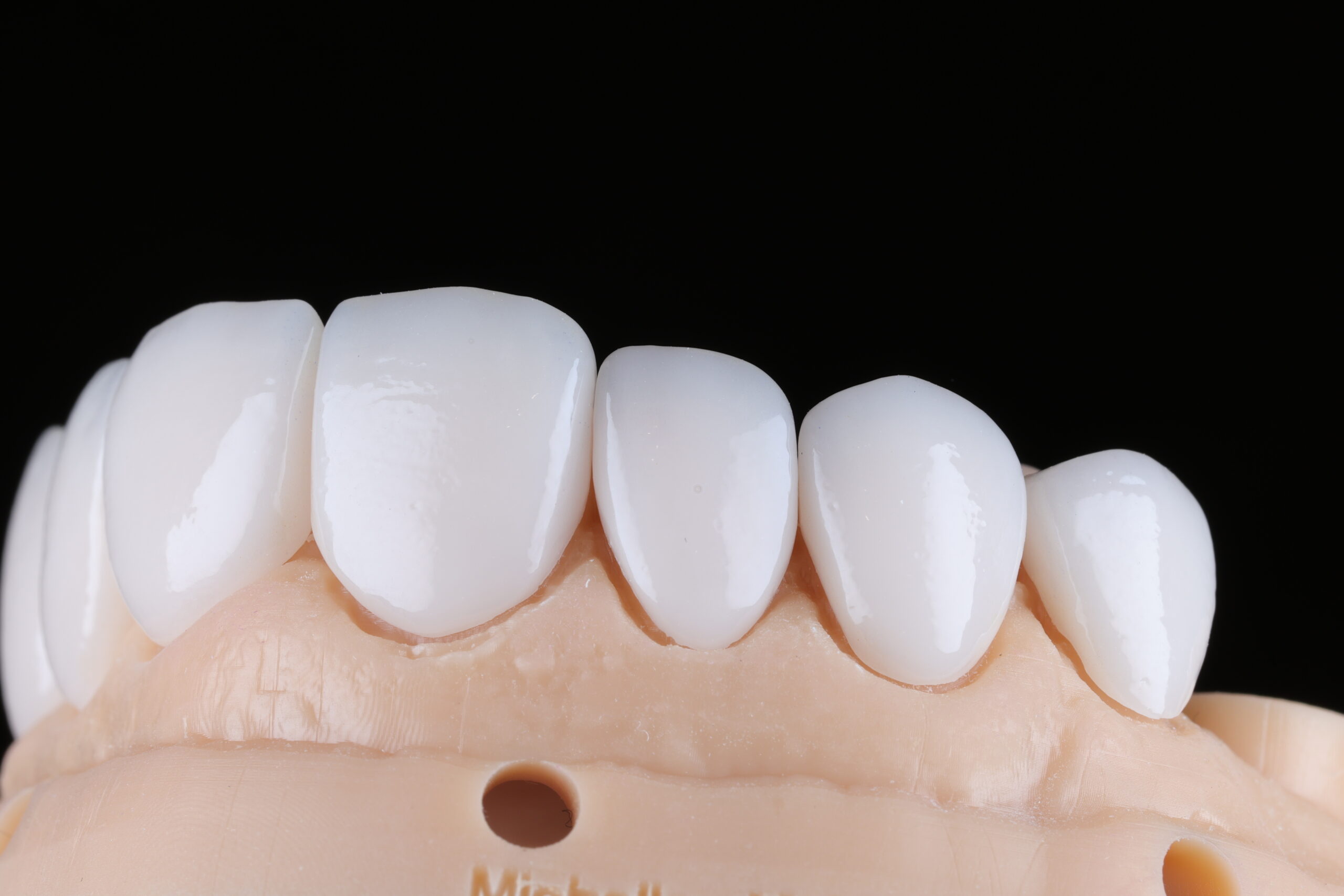

Digital occlusion analysis with MODJaw records a patient’s actual jaw movement — condylar guidance, tooth contacts and functional excursions — and feeds that motion into the design of the restoration. The point is simple but significant: instead of approximating occlusion on an average-value articulator, the lab designs to how this patient’s mandible actually moves. That is the difference between a restoration that seats with even, harmonious contacts and one ground in at the chair. This guide explains what MODJaw captures, what the accuracy evidence shows, and where dynamic occlusion changes the restorative result.
The problem with average-value articulators
Most CAD occlusion is still built on a virtual articulator using arbitrary, average anatomical values — a mannequin’s jaw, not the patient’s. It is a reasonable approximation for a single posterior unit, but it does not reproduce the individual’s condylar path or the timing of their excursive contacts, which is why prosthetic restorations so often need clinical occlusal adjustment to accommodate real mandibular movement.² The larger and more functional the case, the more that approximation costs you in chairside time.
What MODJaw actually captures
MODJaw is a 4D jaw-motion system: it tracks real movement and merges it with the intraoral scan (and, where relevant, CBCT) to build a patient-specific virtual articulator. Rather than static bite records alone, it records functional movement, dynamic tooth contacts and occlusal timing, so the “fourth dimension” — motion over time — is designed in rather than assumed.¹ This is the concept behind 4D dentistry: both static and dynamic parameters are used together for complete diagnosis and truly custom occlusal schemes.
What the evidence shows on accuracy
The accuracy is genuinely laboratory-grade. An in-vitro study of the jaw-tracking technology found its accuracy comparable to industrial scanners and superior to traditional recording methods.¹ Clinically, the system has been used to assess mandibular kinematics in patient populations — for example a study of 154 orthodontic patients using the optical jaw-tracking system — supporting its use as a repeatable diagnostic record rather than a novelty.⁴ A patient-specific virtual articulator built from real motion diagnoses and restores occlusion within the patient’s own physiologic parameters, which a mechanical articulator or a static CAD image cannot.²
Where dynamic occlusion changes the restoration
The cases that benefit most are the ones where occlusion is the hardest part:
- Full-arch and complex rehabilitations — where cumulative occlusal error across many units is exactly what causes remakes and adjustment; designing to real motion is decisive, as it is across full-arch implant restorations.
- Worn dentition and increased vertical dimension — where the new scheme has to function in the patient’s actual envelope of movement.
- Occlusal splints and appliances — where even contacts and correct excursive guidance are the whole therapeutic point, as covered in our occlusal splints guide.
- Multi-unit anterior aesthetics — where guidance and function must sit behind the aesthetics, not fight them.
For a single posterior crown, average-value CAD is usually fine. For anything where dynamic occlusion drives the outcome, motion data earns its place.
How Zenith uses MODJaw
MODJaw occlusion analysis is part of Zenith’s workflow, integrated alongside our digital design tools so functional data informs the restoration from the start. Because the founder is a practising dentist, occlusion is treated as a clinical parameter to be designed — not a variable to be corrected afterwards. We merge your intraoral scan with the motion data, design the occlusal scheme to the patient’s real movement, and return the design for your approval, with the 2% remake rate we hold against an 8–12% industry average reflecting exactly this kind of front-loaded accuracy. You can see how occlusion informs our crown, bridge and implant work across the full range of services, and we accept scans from 3Shape, iTero, Medit, DS Core, Carestream and Smilecloud.
For a full-arch, worn-dentition or complex occlusal case, get in touch and we’ll plan the occlusion with you.
FAQs
Frequently asked questions
Everything you need to know about working with Zenith Labs.
What is digital occlusion analysis with MODJaw?
It is the recording of a patient’s real jaw motion — condylar guidance, functional excursions and dynamic tooth contacts — and its integration with the intraoral scan to build a patient-specific virtual articulator. Restorations are then designed to how the patient actually moves, not to average values.¹
How is 4D jaw tracking different from a CAD virtual articulator?
A standard virtual articulator uses arbitrary average anatomical values. MODJaw captures the individual patient’s actual movement over time (the “4D” element), producing a personalised occlusal scheme rather than an approximation that often needs chairside adjustment.²
Is jaw-motion tracking accurate?
Yes. An in-vitro study reported accuracy comparable to industrial scanners and better than traditional methods, and the system has been used clinically to assess mandibular kinematics in patient studies.¹⁴
Which cases benefit most from dynamic occlusion analysis?
Full-arch and complex rehabilitations, worn dentition and increased-vertical-dimension cases, occlusal splints, and multi-unit anterior work — anywhere dynamic occlusion, not just static contacts, determines the result. A single posterior crown usually does not need it.
What does the lab need to use MODJaw for my case?
An intraoral scan of both arches, the relevant motion record, and — for complex cases — a CBCT to build the full virtual patient. The lab then designs the occlusal scheme to the captured movement before manufacture.
Sources
- PubMed — “In-vitro accuracy of a novel jaw-tracking technology” (accuracy comparable to industrial scanners; superior to traditional methods) — https://pubmed.ncbi.nlm.nih.gov/37777084/
- ScienceDirect, Journal of Prosthetic Dentistry — “Jaw tracking integration to the virtual patient: A 4D dynamic approach” — https://www.sciencedirect.com/science/article/abs/pii/S002239132200110X
- PMC — “Virtual Dental Articulation Using Computed Tomography Data and Motion Tracking” — https://pmc.ncbi.nlm.nih.gov/articles/PMC10669225/
- PMC — “Mandibular Kinematics on an Orthodontic Population Assessed with an Optical Jaw Tracking System: A Comparative Study” — https://pmc.ncbi.nlm.nih.gov/articles/PMC12110127/