


Choosing an implant crown is really two decisions, not one. First, how is the crown retained — screw, cement, or a hybrid of the two? Second, how does it connect to the implant — on a Ti-base or on a custom abutment? Those two axes interact, and the right combination for a given case is driven by implant angulation, the emergence profile the soft tissue needs, the aesthetic demand of the site, the available restorative space, and how retrievable you want the final restoration. This guide works through every option, what the literature actually shows, and a practical framework for deciding.
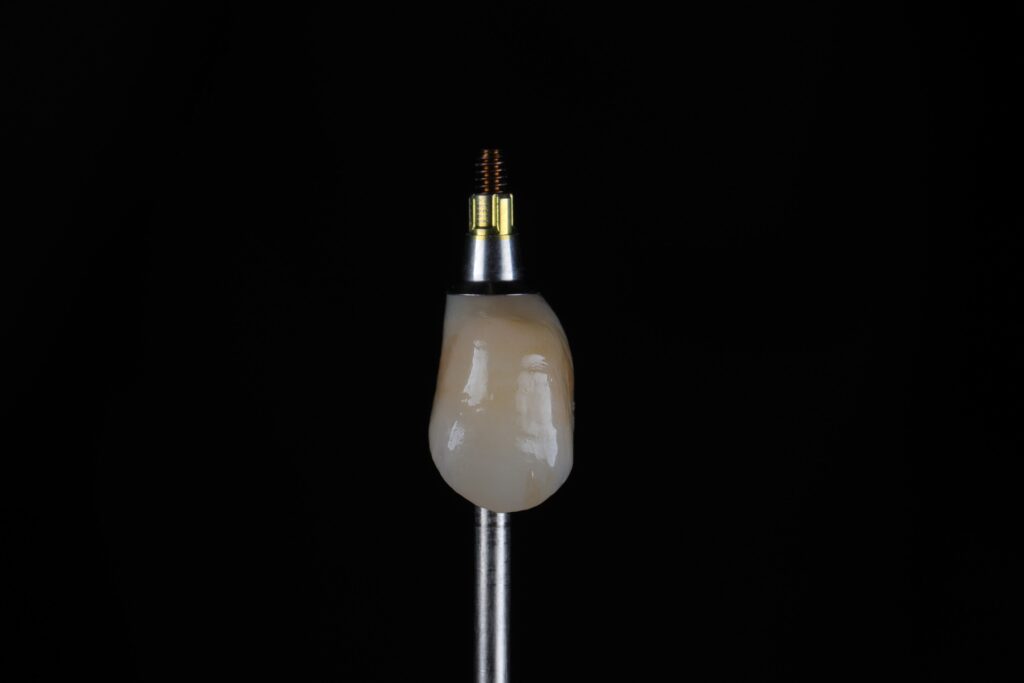
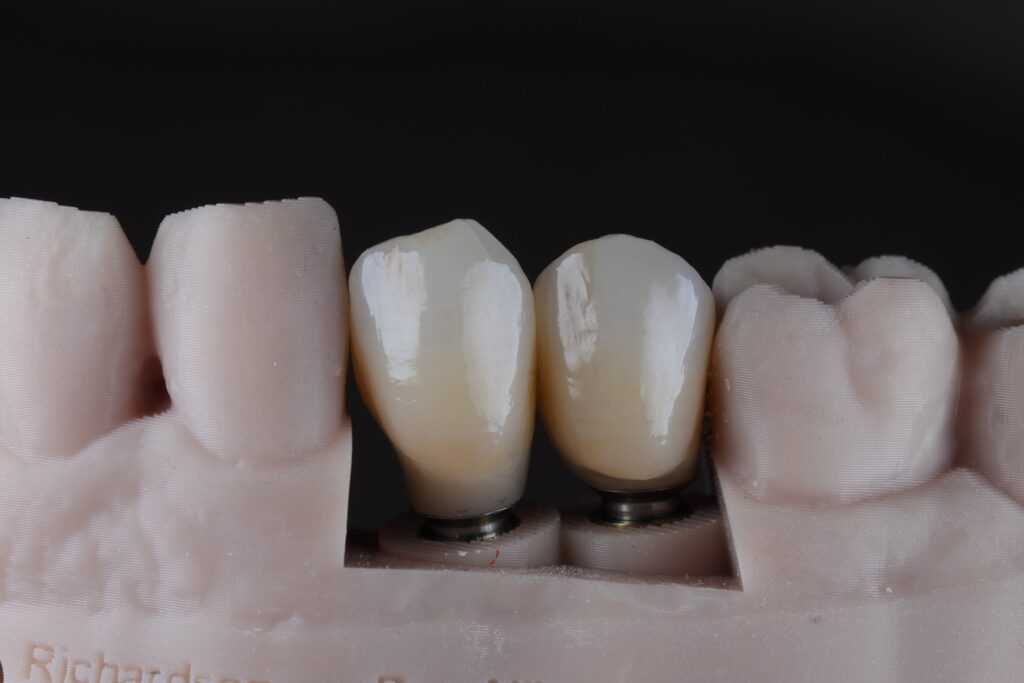
The two decisions behind every implant crown
It helps to keep retention and connection separate in your head, because conflating them is where prescriptions go wrong. A screw-retained crown can sit on a Ti-base or a custom abutment. A cement-retained crown almost always needs an abutment, stock or custom. And a screwmentable crown is, in effect, a cemented crown on a Ti-base that you then deliver with a screw. So the four options most labs list — screw-retained, cement-retained, crowns on Ti-bases, and crowns on CAD/CAM custom abutments — are really points on these two axes, not four unrelated products.
Retention: how the crown attaches
Screw-retained crowns
A screw-retained crown threads directly to the implant or to a screw-retained abutment, with the access channel sealed after torquing. The defining advantage is that there is no cement, which removes the single most preventable biological risk around an implant: residual subgingival cement, recognised as a main causal factor in peri-implant disease.¹ The crown is also retrievable, so screw checks, hygiene access, and repairs are straightforward.
The constraint is the access channel. The screw hole has to emerge somewhere acceptable — the cingulum of an anterior tooth or the occlusal surface of a posterior one — and that depends on the implant being placed along a favourable axis. A traditional straight channel is therefore contraindicated when the hole would exit through the labial face of a restoration.² Screw retention is also frequently preferred where vertical restorative space is limited, because cement retention depends on adequate abutment height for mechanical grip.
Cement-retained crowns
A cement-retained crown is luted onto an abutment, with no occlusal access hole. That buys cleaner aesthetics and an uninterrupted ceramic surface, and an angled or custom abutment can compensate for a less-than-ideal implant axis.³ Cement-retained restorations are also more forgiving where multiple non-parallel implants are splinted.
The cost is the cement. Excess luting agent forced apically is difficult to detect and remove, particularly with deep subgingival margins, and is the principal reason cement-retained restorations carry a higher biological complication rate.¹ Where cement retention is chosen, margin position matters: the deeper the margin, the more undetected cement tends to remain.
Screwmentable (the hybrid)
A screwmentable crown is cemented extraorally onto a Ti-base in the laboratory and then delivered as a screw-retained unit. It keeps the retrievability and cement-free margin of screw retention while giving the lab full control over contour and aesthetics, because the cementation happens on the bench rather than in the mouth. This hybrid has grown in popularity precisely because it sidesteps the residual-cement problem while preserving aesthetic flexibility.⁴
The angulated screw channel (ASC)
The ASC is what has shifted so many clinicians towards screw retention over the last decade. An ASC abutment lets the screwdriver engage the screw off-axis, so the access hole can be relocated away from the labial face. Depending on the system, the channel can be redirected anywhere from 0° up to around 25–30° of the implant axis, in a 360° arc, and still be torqued to the manufacturer’s target.⁵ ⁶ ⁷ The clinical effect is striking: in a CBCT analysis of digitally planned implants in the anterior maxilla, roughly three-quarters required an angled channel, almost all with corrections of 15° or less — and every implant in that scope became restorable as a screw-retained unit, with none needing cement.⁸ ⁹
ASC is not free of trade-offs. The widened channel can thin the facial ceramic and has been associated with porcelain chipping, and the system is only available on specific implant connections.⁵ ⁸ But as a way to keep cement out of the sulcus in off-axis cases, it has changed the default.
Connection: how the crown meets the implant
Crowns on a Ti-base
A Ti-base is a two-piece arrangement: a titanium base that screws into the implant connection, and a milled zirconia or ceramic crown bonded to it. It pairs naturally with a digital workflow — scan, design, mill, bond — and allows extraoral cementation, which is why it has become the efficient default for routine single units where the implant sits in a reasonable position.³ The two-piece design does introduce a bonded interface, so chimney height and bonding protocol matter for long-term retention.
Crowns on a CAD/CAM custom abutment
A custom abutment is milled patient-specifically in titanium or zirconia. It exists to do two things a stock part cannot: correct implant angulation, and carry an emergence profile that supports the soft tissue like a natural tooth.³ ¹⁰ This is the option that earns its place in the aesthetic zone, where margin position and tissue contour decide the result, and wherever the implant axis needs managing. For shade-critical anterior cases, a zirconia abutment (or a zirconia component on a titanium base) avoids the grey show-through of titanium, at the cost of an additional bonded interface.
Stock abutments
Prefabricated stock abutments are quick and inexpensive, but their fixed geometry rarely delivers the emergence, margin position, or angle correction an anterior case needs, and they are frequently inappropriate for the smile zone.¹⁰ They have a place in straightforward posterior cases with favourable angulation.
The evidence: what the literature actually shows
The headline is that survival is comparable. A widely cited systematic review reported five-year survival of around 96.0% for cement-retained and 95.6% for screw-retained reconstructions, with no statistically significant difference,⁹ and a separate review concluded there is no significant difference in implant survival or crown loss between the two — neither is inferior care.² What differs is the type of complication. Biological complications (mucositis, peri-implantitis) skew towards cement, driven by residual cement; technical complications (screw loosening, ceramic chipping) skew towards screw retention.¹ ² Meta-analyses of marginal bone loss have shown only small differences that may not be clinically significant.
So the decision is not “which is better” in the abstract. It is “which is right for this implant, in this position, in this patient” — a case-by-case clinical judgement.
How to choose: a practical framework
| Factor | Points towards screw / screwmentable / ASC | Points towards cement (often on a custom abutment) |
| Implant angulation | Favourable axis, or correctable within ASC range (≤~25–30°) | Off-axis beyond ASC correction |
| Access channel exit | Cingulum / occlusal | Would exit labially |
| Retrievability needed | Yes (maintenance, screw checks) | Less critical |
| Residual-cement risk | Want it eliminated (perio-susceptible, deep margins) | Manageable with supragingival margins |
| Vertical restorative space | Limited | Adequate abutment height available |
| Aesthetic zone | Achievable with ASC + good ceramic management | Uninterrupted ceramic preferred |
Almost every input in that table is fixed at placement. That is the real point: the crown decision is largely a planning decision. It is far easier to keep screw retention and an ideal emergence when the implant position was driven by the final restoration in the first place — the principle behind prosthetically driven digital implant planning. Material choice then follows the case: monolithic zirconia for strength in the posterior, layered zirconia or lithium disilicate where translucency and anterior aesthetics lead.
How Zenith provides these options
Zenith provides a full range of implant crowns, including:
Zenith provides a full range of implant crowns, including:
- Screw-retained implant crowns
- Cement-retained implant crowns (where indicated)
- Crowns on Ti-bases
- Crowns on CAD/CAM custom abutments
Each option is selected against the clinical requirement rather than a default. Because the founder is a practicing dentist, the choice is made the way it has to behave at the chairside, not only the way it mills cleanly. Custom abutments are milled in titanium or zirconia, and crowns in monolithic or layered zirconia and lithium disilicate. Where the implant axis is the limiting factor, the case is flagged early and, when it helps, planned back to the implant position and surgical guide so screw retention stays on the table.
MODJaw informs the occlusion analysis, and the 24–48 hour design preview lets you approve the abutment and emergence profile before anything is manufactured. For a workflow where seating has to be clean first time, the 2% remake rate against an 8–12% industry average is the figure that carries. Turnaround on implant crowns is 7–10 working days, with Express (5 days) and Rush (2–3 days) tiers when a case is time-critical. Cases are accepted from all major implant systems and via intraoral scans from 3Shape, iTero, Medit, DS Core, Carestream and Smilecloud, with conventional impressions where required.
Get in touch
Not sure whether a case should be screw-retained, cement-retained, screwmentable, or built on a custom abutment? Submit your case or email cases@zenithdental.co.uk (response within 4 hours), or call +44 113 548 2598 and we’ll plan the retention and abutment with you.
FAQs
Frequently asked questions
Everything you need to know about working with Zenith Labs.
Screw-retained or cement-retained — which is better?
Neither, universally. Survival rates are comparable, so it is a case decision: screw (or screwmentable) where retrievability and a cement-free margin matter, cement where the implant axis or aesthetics make an access hole impractical.¹ ²
What is an angulated screw channel (ASC)?
A system that lets the screw access be redirected off the implant axis — up to roughly 25–30° depending on the connection — so you can keep a screw-retained restoration even when the implant is not ideally angled, avoiding cement.⁵ ⁷
What is a screwmentable crown?
A crown cemented onto a Ti-base extraorally in the lab and then delivered as a screw-retained unit. It gives the retrievability of screw retention without subgingival cement.⁴
Ti-base or custom abutment?
A Ti-base is efficient for routine single units in a good position. A CAD/CAM custom abutment is the choice when you need to correct angulation, shape the emergence profile, or meet an anterior aesthetic demand.³ ¹⁰
Zirconia or lithium disilicate for the crown?
Monolithic zirconia for strength in load-bearing posterior units; layered zirconia or lithium disilicate where translucency and anterior aesthetics take priority. The connection (Ti-base or abutment) is chosen separately.
Which implant systems do you accept?
All major systems — send the system and connection details with the case.
What do you need to start an implant crown case?
An intraoral scan (or conventional impression) with the implant scan body captured, the implant system and connection, opposing and bite records, and any shade and aesthetic notes.
Sources
- FOR / ITI Foundation — Screw-retained vs. cement-retained (residual cement as a causal risk factor for peri-implant disease) — https://www.for.org/en/treat/treatment-guidelines/single-tooth/treatment-options/treatment-planning/screw-retained-vs-cement-retained
- Systematic review of screw- versus cement-retained implant-supported fixed restorations (PubMed) — no significant survival difference; neither inferior — https://pubmed.ncbi.nlm.nih.gov/24382004/
- Dental Valley — Castable abutments vs Ti-bases: prosthetic control, emergence, angulation (lab perspective) — https://dental-valley.com/blogs/news/castable-dental-abutments-vs-ti-bases-which-offers-better-prosthetic-control
- Fiorillo et al., MDPI (2024) — Single dental implant restoration: cemented or screw-retained? Systematic review of RCTs (hybrid/screwmentable) — https://www.mdpi.com/2673-1592/6/4/63
- FOR / ITI Foundation — Angulated Screw Channel system (ASC): correction up to ~25°, torqued to 35 Ncm; system-specific — https://www.for.org/en/treat/treatment-guidelines/single-tooth/treatment-options/treatment-planning/angulated-screw-channel-system-asc
- Nobel Biocare — Angulated screw channel: 0°–25° access in a 360° radius — https://www.nobelbiocare.com/en-us/angulated-screw-channel-solutions
- Straumann — Angled Solutions: screw channel angulation up to 30° — https://www.straumann.com/en/dental-professionals/prosthetics/angled-solutions.html
- The ability to screw-retain single implant-supported restorations in the anterior maxilla: a CBCT analysis (ScienceDirect) — ~76% needed an angled channel, corrections ≤15° — https://www.sciencedirect.com/science/article/abs/pii/S0022391321000329
- Dimensions of Dental Hygiene — Wittneben et al. 5-year survival 96.03% (cement) vs 95.55% (screw) — https://dimensionsofdentalhygiene.com/screw-vs-cement-retained-prostheses-implant-therapy/
Stomadent — Custom abutment vs stock abutment: angulation correction and emergence profile — https://stomadentlab.com/custom-abutment-vs-stock-abutment/