
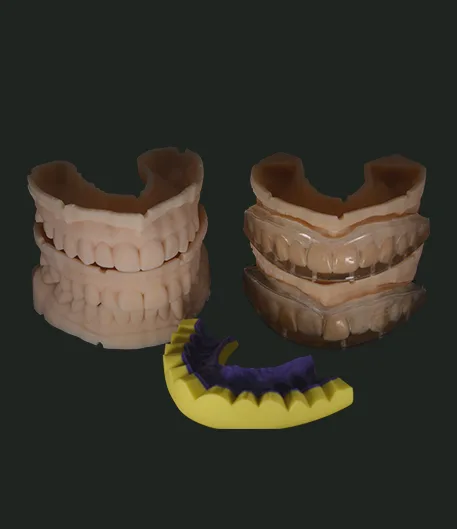

Composite injection moulding is a minimally invasive way to translate a diagnostic wax-up into direct composite restorations, by injecting heated flowable and packable composite through a clear stent onto unprepared teeth. The technique lives or dies on the stent: a precise, transparent injection index — fabricated by the lab from a wax-up or digital design — is what turns a plan into a reproducible result at the chair. This guide explains how the technique works, where it is indicated, why the stent quality is decisive, and how the digital lab workflow makes it predictable.
How the composite injection moulding technique works
The principle is additive, not subtractive. A diagnostic wax-up — analogue or, increasingly, a digital design 3D-printed to a model — defines the target shape, and a transparent silicone index is made over it. That clear stent is the mould: because it is see-through, the composite can be light-cured directly through it.¹
Chairside, the sequence is straightforward and prep-free: isolate and etch, apply the adhesive and immediate dentine sealing, seat the stent, then inject heated flowable composite followed by heated packable composite and cure through the transparent index.¹ The result reproduces the wax-up in composite on teeth that were never drilled. It is one of the few genuinely reversible fixed aesthetic options.
Where it is indicated
The technique suits additive cases where enamel is intact and shape — not shade correction — is the goal:
- Worn dentition — rebuilding lost tooth structure and, where planned, vertical dimension
- Diastema closure
- Peg or undersized lateral incisors
- Class IV fractures and shape modifications
- Transitional prototypes and long-term provisionals — a “test drive” of a planned smile before committing to ceramics
Because no tooth is prepared, it is also a low-risk way to trial a design: an injection-moulded mock-up can preview a case that will later be finalised in feldspathic or pressed veneers, or kept as the definitive composite result where that suits the patient.¹⁴
The stent decides the result
This is where the lab earns its place. The injection index has to capture the wax-up precisely, seat reproducibly, and vent correctly, or the injected composite flashes, voids, or distorts the intended contour. A digital workflow tightens all of this: a digital wax-up designed from a digital smile design is 3D-printed and the clear index made over it, which has been shown to improve predictability, reduce technique sensitivity, and reproduce the planned anatomy accurately.² A stent made from a clean intraoral scan and a well-designed wax-up is the single biggest determinant of whether the chairside injection goes smoothly.
A note on the material
Part of what has made the technique reliable is the material. Modern injectable composites carry a higher filler content than conventional flowables, which improves wear resistance and polish while still flowing under injection — making them suitable for the stress-bearing, additive situations above rather than only superficial repairs.³ Protocols that inject conventional heated resin composites through the stent are also emerging, extending the range of materials that can be used.³
Longevity and limitations
Early clinical data are encouraging — reports show no significant wear or soft-tissue issues at short-term follow-up — but long-term evidence is still limited, so injection-moulded composite should be reviewed like any bonded restoration, watching for marginal discolouration and chipping over time.² It is best framed to patients honestly: a conservative, repairable, aesthetically excellent option that may need maintenance sooner than ceramic, and an ideal transitional step before a definitive restoration.
How Zenith makes your injection moulding stents
Injection moulding stents are a Zenith service. We fabricate the precision stent from your digital design or impressions, built over a wax-up that reflects the final vision, and provide it ready for chairside injection — suitable for veneer cases, crown and bridge work, full-mouth rehabilitations and maintaining vertical dimension. Because the founder is a practising dentist, the wax-up and stent are designed around how the case has to inject and cure at the chair, not just how it looks on a model, and the digital design comes back for your approval within 24–48 hours. You can see the full range of services, and we accept scans from 3Shape, iTero, Medit, DS Core, Carestream and Smilecloud.
For a worn-dentition, diastema or peg-lateral case you want to plan additively, send us the scan and we’ll design the stent with you.
FAQ
FAQs
Frequently asked questions
Everything you need to know about working with Zenith Labs.
What is composite injection moulding?
It is a technique for building direct composite restorations by injecting heated composite through a clear silicone stent onto unprepared teeth, reproducing a diagnostic wax-up. It is additive and minimally invasive — no tooth preparation is required.¹
What is the injection moulding stent?
It is the transparent silicone index the lab fabricates over the wax-up. Being clear, it lets the composite be cured through it, and its accuracy determines how faithfully the injected composite reproduces the planned shape.¹²
When is composite injection moulding indicated?
For additive cases with intact enamel: worn dentition, diastema closure, peg or undersized laterals, Class IV fractures, shape changes, and transitional mock-ups or long-term provisionals.¹⁴
Is the technique reversible?
Largely, yes — because no tooth structure is removed, it is one of the more conservative and reversible fixed aesthetic options, which also makes it ideal for trialling a planned smile before committing to ceramics.
How long do injection-moulded composite restorations last?
Short-term data are promising, with no significant wear reported at early follow-up, but long-term evidence is still limited.² Treat them as bonded restorations that need periodic review and may require maintenance sooner than ceramic — excellent as a definitive option for the right patient and as a transitional one for others.
Sources
PMC — “Enhancing Aesthetics and Functionality of the Teeth Using Injectable Composite Resin Technique” — https://pmc.ncbi.nlm.nih.gov/articles/PMC11162272/
- PMC — “Composite Injection Technique With a Digital Workflow: A Pragmatic Approach for a Protruding Central Incisor Restoration” — https://pmc.ncbi.nlm.nih.gov/articles/PMC11109782/
- Wiley, Journal of Esthetic and Restorative Dentistry (Vargas et al., 2025) — “A Twist on Injection Molding: Injecting Conventional Resin Composites” — https://onlinelibrary.wiley.com/doi/10.1111/jerd.13410
- PMC — “Restoration of a Peg Lateral Incisor Using the Putty Index Technique: A Case Report” — https://www.ncbi.nlm.nih.gov/pmc/articles/PMC11463886/