
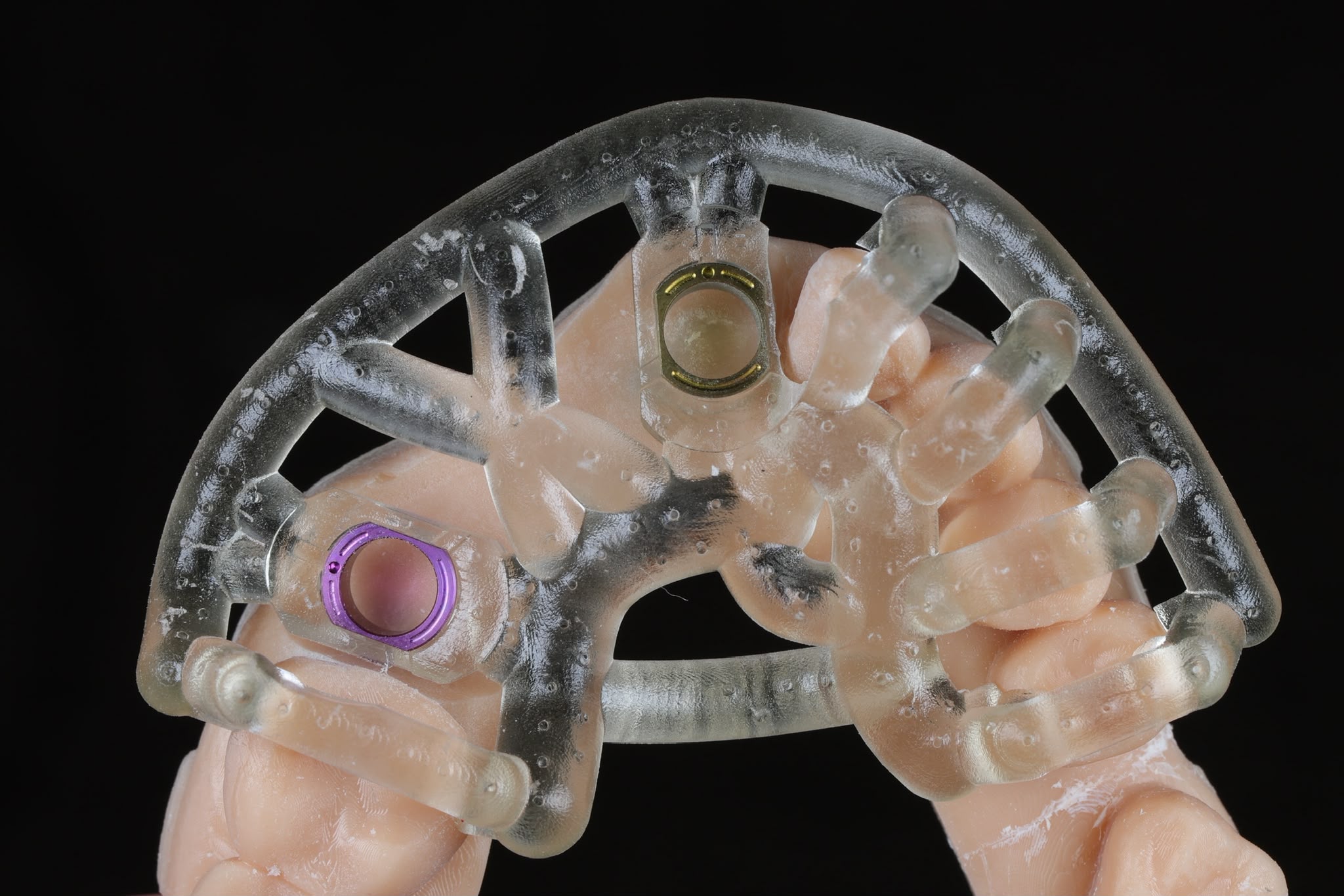

Immediate temporisation means fitting a provisional restoration at the time of implant placement, or within roughly 48 hours of it, rather than waiting out osseointegration.¹ Plan the surgical guide and the provisional from the same dataset and the temporary is ready before the patient is out of the chair. The caveat sits in the case selection: it only holds up when primary stability supports it.
What “immediate temporisation” actually means
The vocabulary gets used loosely, so it is worth being precise. Immediate placement describes the timing of the fixture: an implant placed into a fresh extraction socket. Immediate loading, or immediate function, describes the timing of the restoration, conventionally a prosthesis fitted within 48 hours of placement.¹ For a single unit, that restoration is the immediate provisional, and fitting it is immediate provisionalisation, or immediate temporisation.
These are two independent decisions. You can place immediately and temporise immediately, place immediately and load conventionally, or temporise immediately on a healed ridge. The ITI loading classification formalises these timing protocols, and picking the right one is a case-selection judgement rather than a default.²
When is it indicated?
The non-negotiable prerequisite is primary stability. The literature points to insertion torque around ≥ 35 Ncm, or an ISQ of roughly 65 and above, as the working benchmarks for proceeding to an immediate restoration.³ ⁴ Below those values, a healing abutment and conventional loading is the safer route. Adequate primary stability is what limits micromotion at the interface while bone-to-implant contact matures.³
The usual filters apply beyond stability: sound systemic health, no uncontrolled parafunction, manageable smoking risk, and a prosthetically driven implant position. A provisional torqued into an aesthetic compromise is rarely worth doing. The aesthetic zone is often where the technique earns its place, because the emergence profile of the provisional sets the soft-tissue contour early. Again, only when the case selects for it.
The digital workflow, step by step
What makes immediate temporisation predictable rather than improvised is plganning the guide and the provisional from a single merged dataset, instead of treating them as two separate jobs.
- Capture. A CBCT for bone and a calibrated intraoral scan for the soft tissue and existing dentition. The DICOM and STL files are merged into one planning environment.
- Plan prosthetically. The planned restoration drives the implant position, not the reverse — the principle behind prosthetically driven digital implant planning. This step decides whether a screw-retained provisional is feasible and where the access channel will sit.
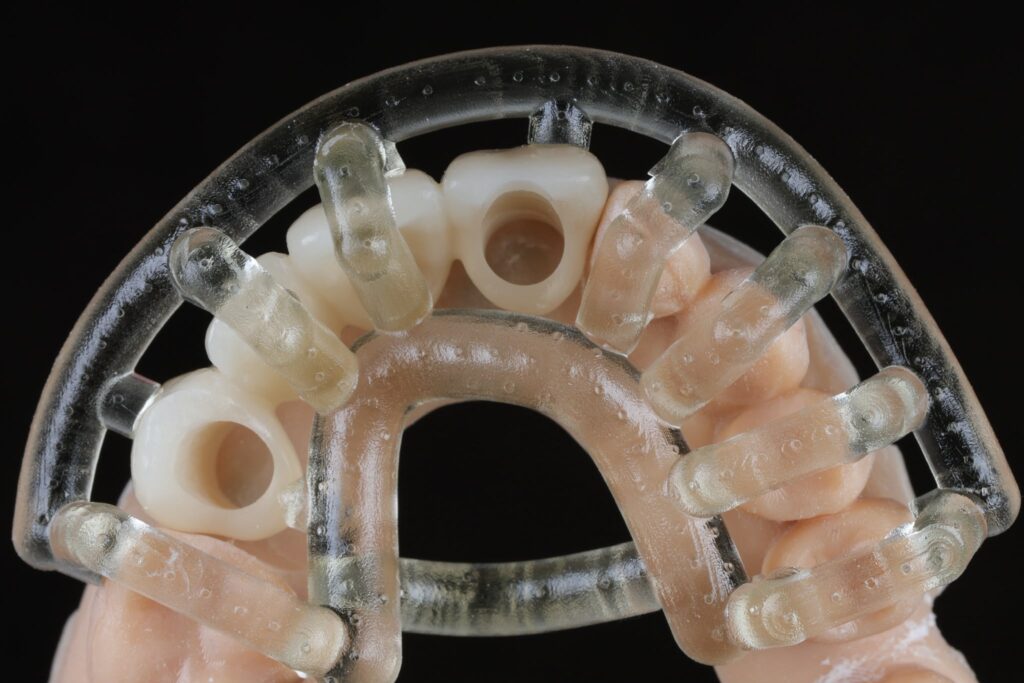
- Design guide and provisional together. Both come from the same plan, so the provisional is built to the implant’s exact intended position. A pre-designed provisional removes the chairside pick-up in many cases and saves real chair time.⁵
- Manufacture. The provisional is milled in PMMA or 3D printed in a suitable resin, alongside the guide.
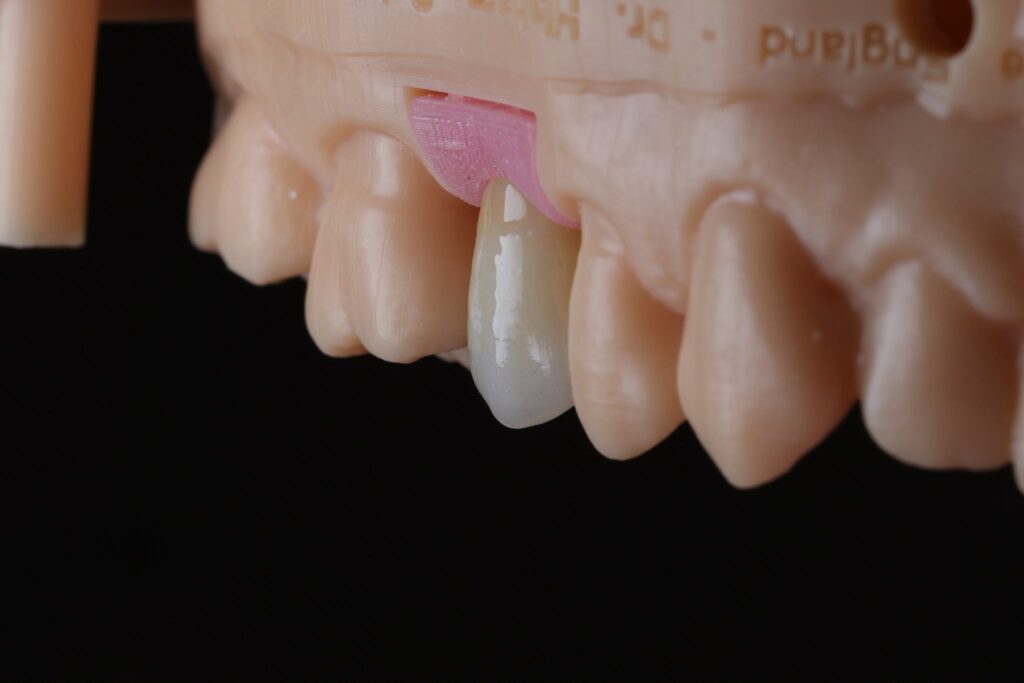
- Place and seat. After guided placement and confirmation of stability, the screw-retained provisional is fitted and adjusted out of occlusion in both centric and excursive movements, so the fixture is protected from functional load during early healing.⁶
One practical advantage of the digital route is that the provisional design is reviewed and signed off before anything is manufactured, which is where most last-minute surprises get caught.⁶
How Zenith supports immediate temporisation
Zenith is a dentist-founded laboratory, and immediate temporisation is the kind of case where a chairside-aware lab perspective pays off. The founder brings 5+ years of clinical and periodontal teaching experience alongside 10+ years in CAD/CAM and smile design, so the provisional is planned the way a clinician needs it to behave in the mouth, not only the way it looks on screen.
In practice that means planning the surgical guide and the immediate provisional from one merged dataset, so the temporary matches the implant’s intended position, with a 24–48 hour design preview for collaborative approval before anything is cut. Smilecloud handles the aesthetic visualisation and case acceptance up front; MODJaw informs the occlusion analysis so the provisional can be taken cleanly out of function. Manufacture runs on multi-axis milling and 3D printing for accurate fit.
When the case progresses to the definitive single-unit or full-arch restoration, the digital record carries through. For a workflow where fit has to be right first time, the lab’s 2% remake rate against an 8–12% industry average is the number that matters most. Turnaround is 7–10 days as standard, with Express (5 days) and Rush (2–3 days) tiers for time-critical cases; complex full-arch timelines are agreed in advance.
Get in touch
Planning an immediate case and want the guide and provisional designed together? Submit your case or email cases@zenithdental.co.uk (response within 4 hours), or call +44 113 548 2598 to talk it through with the team.
FAQs
Frequently asked questions
Everything you need to know about working with Zenith Labs.
What is the difference between immediate loading and immediate temporisation?
Immediate loading is the umbrella term for fitting any restoration within about 48 hours of placement.¹ Immediate temporisation, or immediate provisionalisation, is the specific act of fitting a provisional rather than a definitive restoration in that window. For a single unit, that is almost always the route.
What primary stability do I need to temporise immediately?
The common working thresholds are insertion torque around ≥ 35 Ncm, or an ISQ of roughly 65 and above.³ ⁴ If you do not reach them, place a healing abutment and load conventionally. The case is not lost, only delayed.
Does the provisional contact the opposing teeth?
No. The immediate provisional is fitted out of occlusion in centric and excursive movements, so the integrating fixture is shielded from functional load.⁶
Can the guide and the provisional be made from the same plan?
Yes, and they should be. Designing both from one merged CBCT and intraoral dataset is what makes the provisional fit the implant’s intended position, and lets it be agreed before anything is manufactured.⁵ ⁶
What turnaround should I plan for?
Standard turnaround is 7–10 days, with Express (5 days) and Rush (2–3 days) options. For immediate cases, the design preview is available within 24–48 hours, so the provisional can be approved ahead of the surgical date.
Sources
- Nobel Biocare — Immediate loading: What’s in it for the patient and practice? — https://www.nobelbiocare.com/en-int/blog/science-first/immediate-loading-whats-in-it-for-the-patient-and-practice
- Dental Update — Immediate dental implants: when and how? (ITI placement & loading protocols) — https://www.dental-update.co.uk/content/restorative-dentistry/immediate-dental-implants-when-and-how
- Primary stability of implant placement and loading related to dental implant materials and designs: A literature review (PMC) — https://pmc.ncbi.nlm.nih.gov/articles/PMC10548003/
- Analyzing stability parameters for assessing immediate and early loading of implants (PMC) — https://www.ncbi.nlm.nih.gov/pmc/articles/PMC12697411/
- Dental Economics — Digital implant planning with prefabricated immediate provisional: a digital workflow example — https://www.dentaleconomics.com/science-tech/article/14211746/digital-implant-planning-with-prefabricated-immediate-provisional-a-digital-workflow-example
- The Probe — Case Report: Immediate Loading of Mandibular Implants with Digital Workflow — https://the-probe.co.uk/blog/2025/06/case-report-immediate-loading-of-mandibular-implants-with-digital-workflow/