
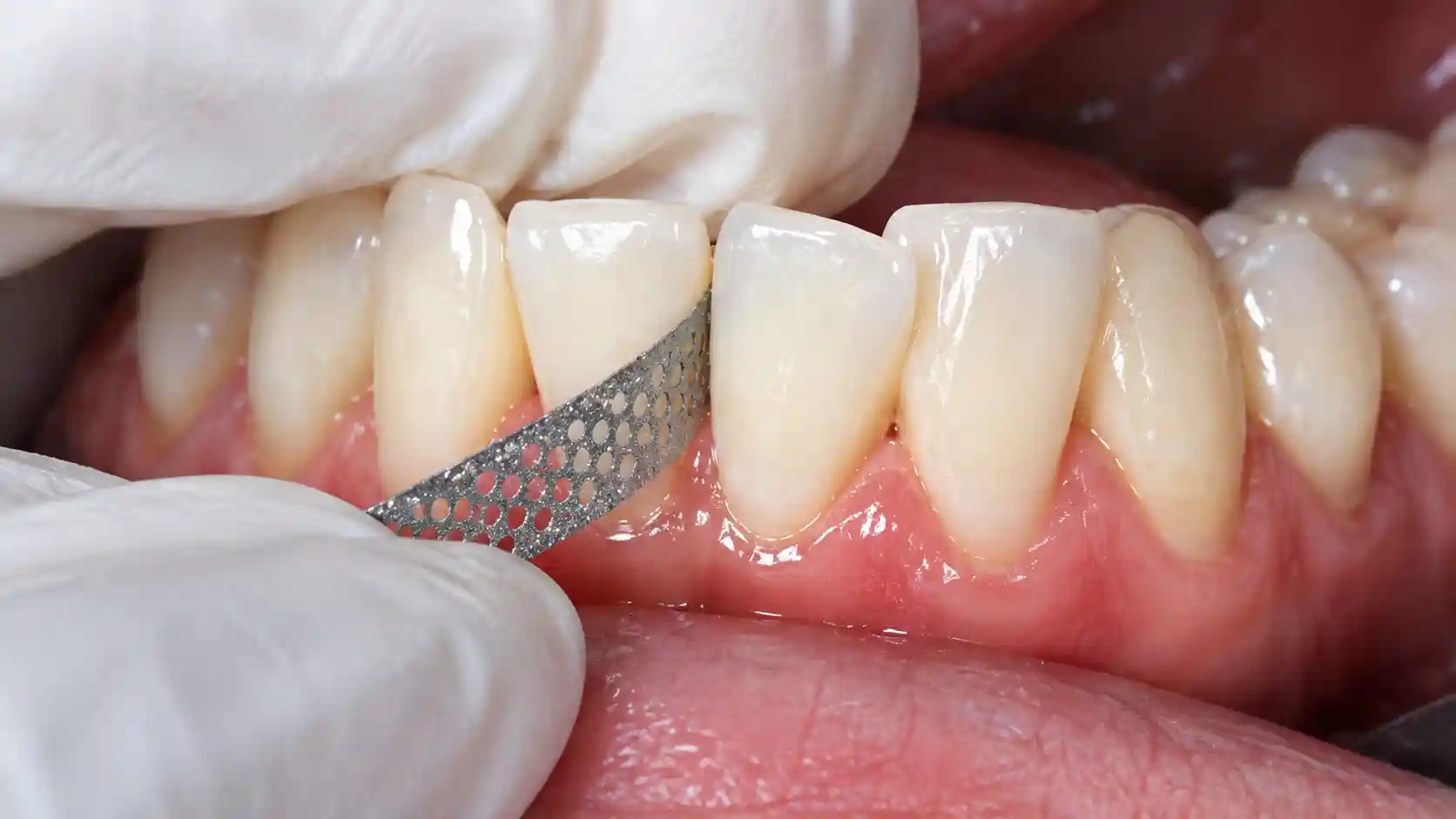

IPR (interproximal reduction) is the controlled removal of a small amount of enamel from the mesial and distal surfaces of teeth to create space, correct tooth-size discrepancies or improve tooth shape. The British Orthodontic Society describes it as removing up to 0.5 mm of enamel from the sides of teeth, and warns that taking too much can harm the teeth.¹ For IPR done within those limits, on the right patient and polished afterwards, the long-term evidence on caries, sensitivity and periodontal health is reassuring.²³⁴
Most of what is written about IPR teeth is aimed at aligner therapy. This guide covers the procedure for the general dentist, then where it meets veneer and composite work.
What IPR in dentistry is used for
IPR was first formally described by Sheridan in 1985, and you will also see it called stripping, slenderising or enamel approximation.² The common indications are:
- Mild to moderate crowding. IPR is an alternative to extraction or expansion when the space deficit is small.⁵ Dahhas and colleagues put the main adult range at roughly 4 to 8 mm of crowding.²
- Tooth-size (Bolton) discrepancy. Dahhas and colleagues quote Bolton’s ideal ratios as 77.2 ± 1.65% for the anterior teeth and 91.3 ± 1.9% for the larger tooth group. When one arch carries excess tooth material, reducing it helps the arches finish with correct overjet and intercuspation.²
- Reshaping. Triangular or bulbous crowns can be recontoured so contacts lengthen and the teeth look more proportionate.²⁵
- Black triangles. Moving a contact point apically by flattening a triangular crown form can reduce open gingival embrasures.⁵
Contraindications
Not every patient is a candidate. The reviews list poor oral hygiene or active periodontal disease, existing hypersensitivity or enamel hypoplasia, naturally small teeth, square or rectangular crown forms, and large pulp chambers in younger patients.² Crowding severe enough to block access to the contacts is also listed; those teeth may need some alignment before any reduction is possible.²
How much IPR is normal?
The BOS figure of up to 0.5 mm of enamel from the sides of teeth is the UK reference point.¹ The literature adds detail:
The practical limit is the enamel in front of you. Proximal enamel thickness varies between teeth and between patients, so the radiographs, crown form and existing restorations should set the ceiling, not the number on a plan. As the Cleveland Clinic puts it for patients, IPR is permanent and irreversible.⁶
- The 50% rule. Around half of the proximal enamel thickness is generally regarded as the maximum that can be removed while still protecting the tooth.²⁵
- Anterior teeth. Dahhas cites a limit of 0.5 mm from lower incisors and upper laterals, with a more conservative school recommending no more than 0.3 mm from upper incisors and 0.2 mm from lower incisors.²
- Buccal segments. Livas and colleagues quote 1 mm per posterior contact (0.5 mm per proximal surface).⁵
- Typical prescriptions. Most planned IPR sits in the range of 0.2 to 0.5 mm per contact.²
Technique: strips, discs and burs
Three families of instrument do most of the work:
Protect the soft tissue. Sheridan’s air-rotor protocol places a 0.020 to 0.030 inch brass or steel wire in the interdental area, and where contacts are very tight, separators left for two to four days anteriorly or a week posteriorly open the contact before you start.²
- 1. Hand-held abrasive strips. Metal strips used freehand or in a holder. Slow, but they reproduce the proximal contour well and suit small amounts and finishing.²⁵
- 2. Diamond discs. Single- or double-sided discs on a slow-speed straight handpiece, plus oscillating segmental discs that improve visual and geometric access.²⁵
- 3. Burs (air-rotor stripping). Fine, safe-tipped burs in a high-speed handpiece.²⁵
Protect the soft tissue. Sheridan’s air-rotor protocol places a 0.020 to 0.030 inch brass or steel wire in the interdental area, and where contacts are very tight, separators left for two to four days anteriorly or a week posteriorly open the contact before you start.²
Heat is the other thing to control. Pulpal temperature rises above 5.5°C are associated with irreversible pulpal change, and a bur held against the tooth for as little as 10 seconds can generate a temperature that poses a risk, so work in short passes with coolant.²⁵
Does technique affect accuracy?
Yes. Executed IPR tends to fall short of what was planned, particularly on lower anterior and upper posterior teeth.² In a prospective trial of 42 patients, mean differences between planned and executed IPR were small with all three methods (0.08 to 0.10 mm), but hand-operated strips under-reduced significantly on upper central incisors and lower canines, while the two motor-driven systems were more accurate overall.⁷ With hand strips, the authors suggest taking slightly more at those sites.
Whatever you use, measure. IPR gauges are thin leaves of set thickness passed through the contact to check the space achieved.²⁵ Check after each pass, and record the amount per contact in the notes against the plan.
Polishing, fluoride and aftercare
Every stripping method roughens enamel, and thorough polishing reduces that roughness significantly.⁵ Topical fluoride afterwards is commonly recommended: Dahhas describes a finishing sequence that ends with fluoride gel, with CPP-ACP varnish as an alternative.² Livas notes that not every author thinks a special fluoride application is needed, so treat it as good practice rather than a proven requirement.⁵
Is IPR safe? What the evidence says
A 2014 systematic review found no statistical difference in caries incidence between stripped and intact surfaces from one to seven years after IPR.³ In Zachrisson’s 10-year follow-up of 61 patients who had all six lower anterior teeth stripped with diamond discs and polished, no new caries lesions were found, gingival health and bone levels were unaffected, and 59 patients reported no increased temperature sensitivity.⁴ A posterior study by the same group found new lesions on 2.5% of stripped surfaces against 2.4% of unground control surfaces four to six years later.⁸
A 2022 systematic review of eight clinical studies found no increase in demineralisation, caries, periodontal change or sensitivity after IPR, but rated the overall quality of evidence as low to very low.⁹ The fair summary: IPR within recognised limits, polished, in a patient with good hygiene, has not been shown to cause harm.⁸ Patients may notice short-lived sensitivity, which usually settles within a few days.⁶
IPR for aligners and remotely planned cases
When a patient arrives with an aligner plan asking you to carry out the IPR, the BOS position is clear. It advises that a full clinical examination by an orthodontic specialist or a dentist experienced in orthodontics should precede any orthodontic plan, and that whoever is responsible for the treatment plan should carry out the IPR.¹ Otherwise you are removing tooth tissue irreversibly on someone else’s prescription.
IPR in restorative and veneer planning
IPR also comes up in aesthetic cases: widening a narrow lateral with veneers or composite may call for a little reduction on a bulky neighbour, and flattening a triangular contact before bonding can reduce a black triangle.⁵
The principle is the same as for veneer preparation. The target shape has to exist before any enamel is removed, because only then can you see which contacts actually need reducing and by how much. A digital smile design or wax-up gives you that target. Compared against the patient’s current teeth, it shows where the planned outline sits inside the existing tooth and where it is purely additive. Sometimes the proportions can be corrected additively, with little or no reduction. Our guide to veneer materials and preparation covers how that planning protects enamel in veneer cases.
If the plan relies on moving teeth, it is an orthodontic case and should be planned and consented as one. Either way, approve the restorative design before any IPR, so the reduction serves an agreed result.
How Zenith supports IPR decisions in aesthetic cases
Zenith does not make aligners or plan orthodontic tooth movement. Where we come in is the restorative side of the question: how much space a veneer or composite plan really needs.
For aesthetic cases we design in Smilecloud, where you upload the clinical records and our technicians annotate and adjust the proposal with you before anything is made. The Smilecloud smile design workflow gives you a design aligned to facial reference points and tooth proportions that you can review, share with the patient and approve. The digital design preview comes back within 24 to 48 hours, so you can decide on any IPR against an agreed plan rather than at the chair.
Once the design is approved, it can go straight into the restorations. For additive composite work, we make composite injection moulding stents over the approved wax-up, so the composite reproduces the same proportions you planned the IPR around. Because the founder is a practising dentist, we plan with the chairside reality in mind, and our remake rate sits at 2% against an 8 to 12% industry average. We accept scans from 3Shape, iTero, Medit, DS Core, Carestream and Smilecloud.
If you have a veneer or composite case where you are weighing up IPR, send us the records and talk to us about the case, or call +44 113 548 2598. Case submissions go to cases@zenithdental.co.uk.
FAQs
Frequently asked questions
Everything you need to know about working with Zenith Labs.
What is IPR in dental treatment?
IPR, or interproximal reduction, is the removal of a small amount of enamel from the contact surfaces between teeth. It creates space for alignment, corrects tooth-size (Bolton) discrepancies and can reshape triangular teeth. The BOS describes it as removing up to 0.5 mm of enamel from the sides of teeth.¹²
How much IPR is normal?
Most planned IPR falls between 0.2 and 0.5 mm per contact, and the BOS describes removing up to 0.5 mm of enamel from the sides of teeth.¹² Around half of the proximal enamel is generally treated as the maximum. Lower incisors have thinner proximal enamel, so more conservative limits (as little as 0.2 mm) are often recommended there.²⁵
Is IPR on teeth safe?
Within recognised limits and followed by polishing, the evidence is reassuring. A 2014 systematic review found no difference in caries between stripped and intact surfaces over one to seven years, and a 10-year follow-up found no new caries or periodontal problems.³⁴ The overall quality of the evidence is still rated low.⁹
Does IPR cause tooth sensitivity?
Any sensitivity is usually short-lived and settles within a few days.⁶ In a 10-year follow-up, 59 of 61 patients reported no increased temperature sensitivity, and a 2022 systematic review found no lasting sensitivity after IPR.⁴⁹ Pre-existing hypersensitivity is a contraindication.²
Should I do IPR before veneers?
Only once the final design is agreed. A smile design or wax-up shows whether any contact actually needs reducing; often proportions can be corrected additively with little or no IPR. If the plan relies on moving teeth, treat it as an orthodontic case and plan it accordingly.¹⁵
Sources
- British Orthodontic Society: “BOS Statement: Interproximal reduction” (24 Oct 2016): https://bos.org.uk/statements/bos-statement-interproximal-reduction/
- Dahhas FY, et al. “The Role of Interproximal Reduction (IPR) in Clear Aligner Therapy: A Critical Analysis of Indications, Techniques, and Outcomes.” Cureus, 2024;16(3):e56644: https://pmc.ncbi.nlm.nih.gov/articles/PMC11032144/
- Koretsi V, Chatzigianni A, Sidiropoulou S. “Enamel roughness and incidence of caries after interproximal enamel reduction: a systematic review.” Orthod Craniofac Res, 2014: https://pubmed.ncbi.nlm.nih.gov/24011354/
- Zachrisson BU, Nyøygaard L, Mobarak K. “Dental health assessed more than 10 years after interproximal enamel reduction of mandibular anterior teeth.” Am J Orthod Dentofacial Orthop, 2007: https://pubmed.ncbi.nlm.nih.gov/17276856/
- Livas C, Jongsma AC, Ren Y. “Enamel Reduction Techniques in Orthodontics: A Literature Review.” Open Dent J, 2013;7:146–151: https://pmc.ncbi.nlm.nih.gov/articles/PMC3831306/
- Cleveland Clinic: “Interproximal Reduction (IPR): Purpose & Benefits”: https://my.clevelandclinic.org/health/treatments/interproximal-reduction
- Güleç-Ergün P, et al. “Comparison of the accuracy of three interproximal reduction methods used in clear aligner treatment.” Clin Oral Investig, 2024: https://pmc.ncbi.nlm.nih.gov/articles/PMC10788318/
- Zachrisson BU, Minster L, Ogaard B, Birkhed D. “Dental health assessed after interproximal enamel reduction: caries risk in posterior teeth.” Am J Orthod Dentofacial Orthop, 2011: https://pubmed.ncbi.nlm.nih.gov/21195282/
- Gómez-Aguirre JN, et al. “Effects of interproximal enamel reduction techniques used for orthodontics: A systematic review.” Orthod Craniofac Res, 2022: https://pubmed.ncbi.nlm.nih.gov/34865310/