
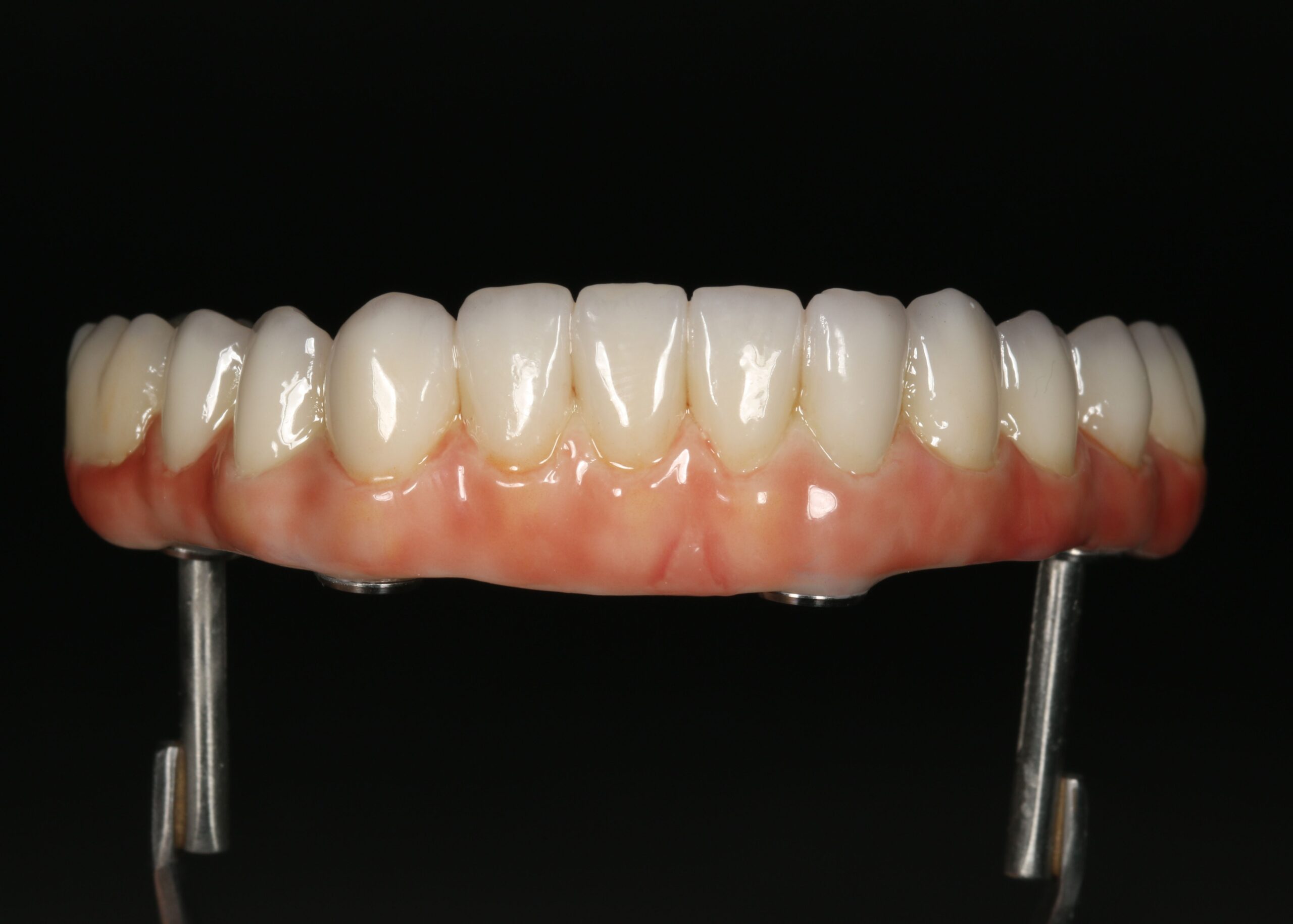

All-on-4 is a full-arch rehabilitation that supports a fixed prosthesis on four implants — typically two axial implants anteriorly and two implants tilted to engage better posterior bone and avoid critical anatomy — usually with an immediate provisional fitted on the day of surgery. The implant component is well evidenced; where full-arch cases are won or lost is in the restorative planning: how much prosthetic space you have, which material the definitive bridge is made from, and how cleanly the surgical and restorative workflows are linked. This guide covers the decisions that sit with you and the lab.
What the evidence says about the concept
The rationale for tilting the posterior implants is simple — it lets you place longer implants in available bone, reduce or avoid grafting, and spread the anteroposterior support without the second-stage surgery a posterior axial implant might need. Systematic reviews of the all-on-four concept report high implant survival and consider immediate function with combined axial and tilted implants a predictable approach.¹
Importantly for case discussions, tilting the implants does not penalise survival. A systematic review of axial versus tilted implants in all-on-four rehabilitations found no significant difference between them, with reported one-year survival around 96.0% for axial and 94.6% for tilted implants.² That gives you a defensible answer when a patient asks whether the “angled” implants are a compromise — on the survival data, they are not.
All-on-4 or all-on-6?
The choice is driven by bone, arch, and load, not by a fixed rule. Four implants are often sufficient in the mandible, where bone quality is typically more favourable. In the maxilla — softer bone, sinus pneumatisation, longer lever arms — many clinicians prefer additional implants for a larger anteroposterior spread and more support under a longer span. A heavy bruxist, a long maxillary arch, or a plan for a monolithic zirconia bridge (heavier and less forgiving of flexure) all push toward six. Decide the implant number and the prosthesis material together, because the second constrains the first.
Choosing the definitive prosthesis: titanium-acrylic or zirconia
This is the material decision that defines the case for the next decade, and the evidence increasingly favours monolithic zirconia for the definitive bridge.
A titanium bar with acrylic and denture teeth is repairable and shock-absorbing, but its delayed complications are well documented — fracture and debonding of the acrylic teeth, wear, and occasional framework problems.⁴ Full-arch monolithic zirconia, by contrast, shows high survival and minimal complications across the available reviews.³ A retrospective comparison reported five-year prosthetic survival of 93.7% for zirconia-based full-arch prostheses versus 83.0% for metal-acrylic, with the metal-acrylic group experiencing more delayed complications; the zirconia option carried a higher initial cost but did not differ greatly once maintenance was accounted for.⁴ Peri-implant health and implant survival were comparable between materials, so the decision sits at the prosthetic level, not the implant level.⁴
The practical translation: if the patient can accept the cost and you have the prosthetic space for an adequately thick zirconia bridge, monolithic zirconia is usually the more durable definitive. The same monolithic-versus-layered and polish-not-glaze principles from our zirconia crown material guide apply at full-arch scale, only the consequences of getting them wrong are larger.
Prosthetic space is the planning constraint
Before any of this, the case has to be designed around the restorative envelope. The vertical space from the implant platform to the planned incisal/occlusal position dictates what material is even possible — too little space and a zirconia bridge cannot be made thick enough to be safe, which is what bone reduction at surgery is often planning for. Thinking in restorative terms (the prosthesis the patient needs first, the implants positioned to serve it) is exactly why a digitally planned implant case starts from the desired tooth position and works backwards to implant placement and the surgical guide.
The full-arch workflow, end to end
A clean full-arch case runs as one continuous digital chain: diagnostic records and a smile design, CBCT and intraoral scans merged for backward planning, a surgical guide produced for placement, an immediate provisional ready for the day of surgery, and — after healing and verification — the definitive bridge. The immediate provisional is its own discipline; planning the immediate temporisation before the patient leaves the chair is what keeps the soft-tissue result and the occlusion under control during osseointegration.
Zenith was founded by a practising dentist, so full-arch cases are handled as a clinical conversation, not a drop-off. We plan from your scans and CBCT, produce the guide and the provisional, and design the definitive bridge for your approval before it is milled — with a digital design preview back to you in 24–48 hours and a 2% remake rate across our restorative work. You can see the full-arch implant restoration services we offer, and we accept scans from 3Shape, iTero, Medit, DS Core, Carestream and Smilecloud.
Working with Zenith on full-arch cases
Full-arch rehabilitation rewards planning the whole sequence before the first implant goes in. If you have a case on the table, send it through and we’ll plan it with you — from the surgical guide and immediate provisional to the definitive zirconia or hybrid bridge.
FAQs
Frequently asked questions
Everything you need to know about working with Zenith Labs.
What is All-on-4?
All-on-4 is a fixed full-arch restoration supported by four implants — usually two placed axially at the front and two tilted at the back to use available bone and avoid grafting — with a provisional bridge often fitted the same day. The definitive bridge follows once the implants have integrated.
All-on-4 or all-on-6 — how do I choose?
It depends on bone quality, arch and occlusal load. Four implants often suffice in the mandible; the maxilla, longer arches, heavy bruxists, and monolithic zirconia bridges frequently favour six for a wider anteroposterior spread and more support. Decide the implant number and the prosthesis material together.
How do I submit my first case?
Are tilted implants as reliable as straight ones?
Yes. A systematic review of all-on-four rehabilitations found no significant survival difference between tilted and axial implants, with reported one-year survival around 96.0% for axial and 94.6% for tilted.² Tilting is what allows longer implants and graft avoidance.
Titanium-acrylic hybrid or zirconia for the final bridge?
Monolithic zirconia tends to be the more durable definitive, with higher prosthetic survival and fewer delayed complications than metal-acrylic, which is more prone to acrylic tooth fracture and wear.³⁴ Zirconia costs more up front and needs adequate prosthetic space; the hybrid remains a valid, repairable option where space or budget is limited.
What records does the lab need for a full-arch case?
A CBCT, intraoral scans of both arches, a bite/jaw-relation record, and ideally a smile design or denture set-up that defines the target tooth position. Planning the prosthesis first lets the implants and surgical guide be designed to serve it.
Sources
- PMC — “The all-on-four treatment concept: Systematic review” — https://pmc.ncbi.nlm.nih.gov/articles/PMC5347302/
- PubMed — “Survival rates of axial and tilted implants in the rehabilitation of edentulous jaws using the All-on-four concept: A systematic review” — https://pubmed.ncbi.nlm.nih.gov/33835063/
- MDPI — “The Success and Complications of Complete-Arch Implant-Supported Fixed Monolithic Zirconia Restorations: A Systematic Review” — https://www.mdpi.com/2673-1592/5/2/29
- ResearchGate — “Long-term Clinical Outcomes and Cost-Effectiveness of Full-Arch Implant-Supported Zirconia-Based and Metal-Acrylic Fixed Dental Prostheses: A Retrospective Analysis” — https://www.researchgate.net/publication/339758830