


An e.max (lithium disilicate) crown is the material of choice when aesthetics and adhesive bonding matter most — anterior single units, veneers, inlays and onlays — while zirconia is the stronger option for high-load posterior crowns, implant restorations and bruxists. The two are not interchangeable, and choosing between them comes down to three things: how much load the restoration will take, whether you can bond it, and how much the optics matter. Here is how the decision actually plays out at the bench and the chairside.
The strength gap is real, but it isn’t the whole story
Lithium disilicate is a glass-ceramic with roughly 70% lithium disilicate crystals in a glassy matrix, giving a flexural strength of about 360 MPa for the CAD (milled) form and up to 400 MPa for the pressed form.¹ Zirconia sits far above that — 3Y-TZP delivers on the order of 900–1,200 MPa, roughly two to three times the strength of e.max.¹
That gap tells you where each material belongs, but raw flexural strength is misleading if you stop there. E.max reaches its working strength when it is adhesively bonded: etched with hydrofluoric acid, silanated, and resin-cemented so the crown and tooth behave as one unit.¹ Bonded properly, lithium disilicate can be made thin — down to around 1 mm — without fracturing, which is exactly what makes it a veneer and onlay material. Take away the bond and you take away much of its clinical performance, so e.max is only the right call where you can achieve reliable isolation and adhesion.
Where e.max wins

The anterior single crown is lithium disilicate’s home ground. Its translucency, fluorescence and the way it handles light are difficult for even high-translucency zirconia to match, so for a central incisor next to natural teeth, e.max usually gives the more convincing result. It is also the default for veneers, inlays and onlays, where conservative, bonded, partial-coverage restorations play to every one of its strengths — the same aesthetic, adhesive thinking that runs through aesthetic anterior work.
The clinical evidence backs the durability. Lithium disilicate crowns have shown a cumulative survival rate of around 97.4% at five years and 94.8% at eight years,² so within its indications e.max is not a compromise on longevity — only on load.
Where zirconia wins
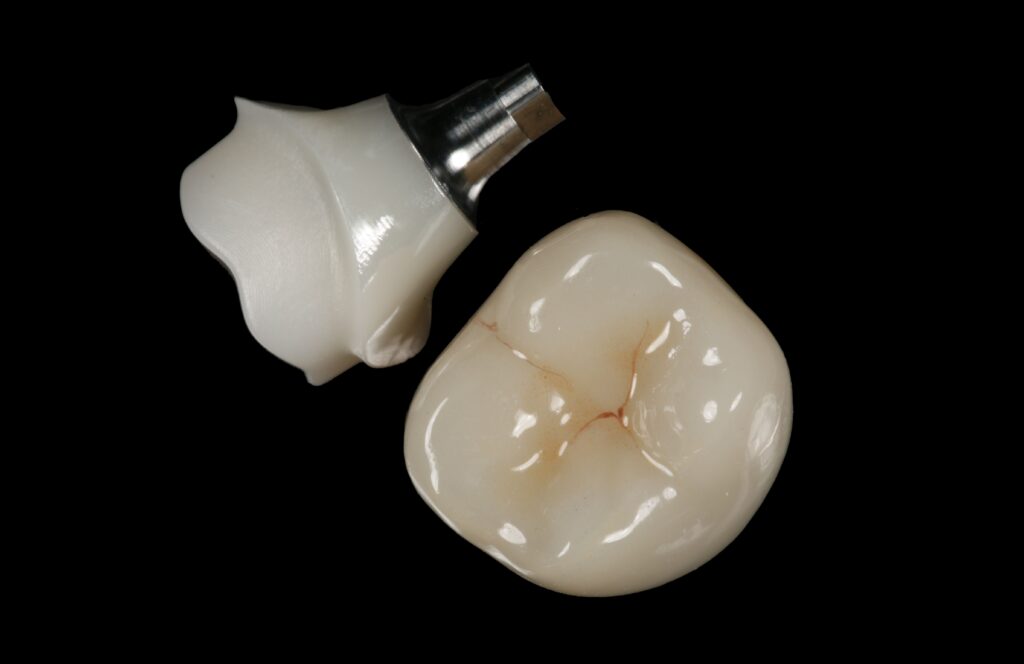
For anything carrying heavy occlusal load, zirconia is the safer and more conservative choice: second molars, long-span bridges, parafunction, and most implant-supported crowns, where the restoration cannot rely on an adhesive bond to a vital tooth. Zirconia’s strength lets it be conventionally cemented and tolerate the higher forces those cases generate — which is why, when you weigh up the material for an implant crown, zirconia is so often the answer. A retrospective comparison of the two materials found zirconia performing well in exactly these higher-load, longer-term scenarios.³
If you want the full picture on zirconia grades, monolithic versus layered, and antagonist wear, that sits in our dedicated zirconia crown guide (published separately in this series).
A simple decision framework
Rather than defaulting to one material, run each case through three questions:
- Load — anterior or low-load, e.max is on the table; heavy posterior load, bruxism, or long span, lean zirconia.
- Bond — can you reliably isolate and adhesively bond? If not (subgingival margins, poor moisture control, an implant abutment), zirconia’s conventional cementation is the pragmatic choice.
- Aesthetics — a single anterior unit beside natural teeth favours e.max; a posterior crown that no one will scrutinise does not need it.
Most disagreements about “e.max vs zirconia” disappear once the case is defined by those three axes rather than by a general preference.
How Zenith makes the call with you
Zenith was founded by a practising dentist, so when a case sits on the fence — an aesthetic premolar, a bonded onlay on a heavily restored tooth, a bruxist who still wants an anterior result — we would rather have that conversation before the crown is designed than after it is tried in. We mill both lithium disilicate and zirconia, capture your margins from an intraoral scan, and return a digital design preview within 24–48 hours for your approval. Across our restorative work we hold a 2% remake rate against an 8–12% industry average, and we accept scans from 3Shape, iTero, Medit, DS Core, Carestream and Smilecloud.
If you have a borderline case, send it through and we’ll plan the material with you.
FAQs
Frequently asked questions
Everything you need to know about working with Zenith Labs.
E.max or zirconia — which is better?
Neither is universally better; they suit different cases. E.max (lithium disilicate) is the choice for anterior aesthetics, veneers, inlays and onlays where the restoration can be adhesively bonded. Zirconia is stronger and better for high-load posterior crowns, long-span bridges, bruxists and implant crowns.
Is e.max strong enough for molars?
It can be used on molars when adhesively bonded and given adequate thickness, but for heavy occlusal load, parafunction or where bonding is compromised, zirconia’s higher flexural strength (around 900–1,200 MPa versus 360–400 MPa for e.max) makes it the safer choice.¹
Does e.max have to be bonded?
Effectively, yes. Lithium disilicate reaches its clinical strength through adhesive resin cementation after hydrofluoric acid etching and silanation.¹ If you cannot achieve reliable isolation and adhesion, choose a material that can be conventionally cemented, such as zirconia.
How long do e.max crowns last?
Clinical studies report cumulative survival of roughly 97.4% at five years and 94.8% at eight years for lithium disilicate crowns within their indications.² Longevity depends heavily on correct case selection and a sound adhesive protocol.
Which is more aesthetic?
E.max generally gives the more natural anterior result because of its translucency and light-handling, though modern high-translucency zirconia has narrowed the gap and remains preferable where strength is the priority.
Sources
- PMC — “Current status on lithium disilicate and zirconia: a narrative review” — https://pmc.ncbi.nlm.nih.gov/articles/PMC6610968/
- PubMed — “Clinical results of lithium-disilicate crowns after up to 9 years of service” — https://pubmed.ncbi.nlm.nih.gov/22392163/
- MDPI, Biomimetics — “Comparison of Long-Term Clinical Outcomes of Zirconia and Lithium Disilicate Prostheses: A Retrospective Cohort Study” — https://www.mdpi.com/2313-7673/10/11/740