
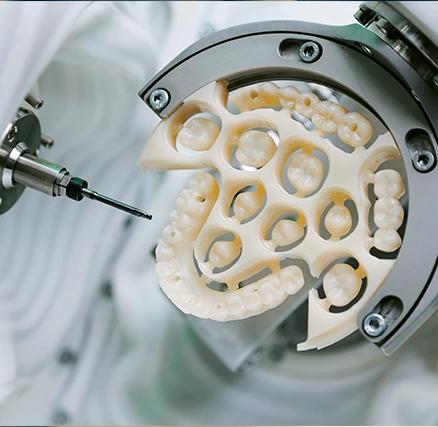

CAD/CAM dentistry is the use of computer-aided design (CAD) and computer-aided manufacturing (CAM) to design and produce dental restorations and appliances from digital data, connecting scanning, digital design and computer-controlled manufacture — milling or additive 3D printing — into one controlled workflow.¹ For the referring dentist the important point is not the software; it is what happens downstream: how accurately a preparation is transferred into a restoration, how consistently that restoration is manufactured, how quickly a case moves through the lab, and how much avoidable variation is removed.
What is CAD/CAM dentistry?
CAD is the design stage: scan data builds a virtual model of the preparation, adjacent teeth, opposing arch and occlusion, and the restoration is designed in dedicated dental CAD software. CAM is the manufacturing stage: the design is translated into machine instructions and the restoration is milled from a prefabricated block or disc, or produced additively by 3D printing.¹²
That makes CAD/CAM more than a digital impression. The scan is the starting point; the value comes from keeping the digital dataset intact through design and manufacture, without repeatedly converting it into physical models or reproducing geometry by hand. The technology now spans crowns, inlays, onlays, veneers, fixed prostheses and implant components.² It is worth separating the terms: digital dentistry is the broad category, and CAD/CAM is the design-and-manufacturing component within it.
The digital workflow: scan → design → mill or 3D print
A laboratory CAD/CAM case runs in three linked stages. First, an intraoral scan (or a scanned conventional impression) captures the preparation and occlusion — the quality of everything downstream depends on a clean digital impression with a clear margin. Second, the restoration is designed in CAD, where margins, contacts, emergence and occlusion are set on screen and can be reviewed before anything is produced. Third, CAM manufactures it — multi-axis milling for ceramics and metals, or 3D printing for models, provisionals and selected appliances.
Because the dataset stays digital, revisions can be made without repeating the whole process, and the case is traceable from scan to finished unit.
How accurate is CAD/CAM dentistry?
Accuracy is the reason it matters clinically, and marginal fit is the usual measure. Marginal discrepancies of roughly 50–120 µm are widely regarded as clinically acceptable for long-term success.¹⁵ CAD/CAM restorations consistently fall within — and often better than — that range: a systematic review and meta-analysis found CAD/CAM ceramic crowns showed marginal gaps comparable or superior to conventional techniques,⁸ and systematic reviews of inlay/onlay and partial-coverage restorations report fit within accepted thresholds.⁴⁵
The detail worth knowing is that fit varies with restoration type and system. In a comparison of chairside restorations, crowns tended to show the smallest marginal gaps and onlays the largest, with newer scanners improving results.⁶ Laboratory-fabricated zirconia crowns likewise show fit differences between a lab workflow and a central milling centre.⁷ The practical message: CAD/CAM raises the floor on fit, but preparation design, scan quality and the material still decide the result.
Chairside vs laboratory CAD/CAM
Both routes use the same principle; they differ in where and how the work is done. Chairside CAD/CAM designs and mills in the surgery for a same-day restoration, with fewer procedural steps — which can reduce some sources of variation.⁶ Laboratory CAD/CAM sends the scan to the lab, where technician expertise, the full range of materials and finishing, and the capacity for complex or larger cases come into play. Chairside suits straightforward single units when speed is the priority; the lab route suits aesthetic anterior work, implant restorations, full-arch and multi-unit cases where material choice and technician skill are decisive.
Materials milled and printed
Part of what makes CAD/CAM dependable is the material set. Milled options include lithium disilicate and other glass-ceramics, monolithic and multilayer zirconia, hybrid ceramics and PMMA for provisionals; additive manufacturing covers models, provisionals and selected appliances.³⁹ These materials show strong mechanical performance and biocompatibility in the current evidence,³¹⁰ and material choice follows the case in the same way it does for any restoration — an issue we cover for load-bearing and aesthetic units in our implant crown material guidance.
What CAD/CAM changes for the practice
Stripped of the marketing, CAD/CAM changes four things a dentist actually feels: fit becomes more predictable and reproducible across cases; turnaround shortens because the dataset never leaves the digital chain; communication improves, since a design can be reviewed and approved before manufacture — the principle behind digital planning tools such as Smilecloud digital smile design; and remakes fall, because much of the analogue variation is removed. The dentist still owns the diagnosis, preparation and prescription — CAD/CAM makes the downstream more consistent, not the clinical judgement.
How Zenith’s CAD/CAM workflow supports you
Zenith Dental Labs is a dentist-founded, UK-based digital dental laboratory built around CAD/CAM, multi-axis milling and 3D printing, so each case is matched to the right manufacturing route rather than forced through one method. We accept scans from 3Shape, iTero, Medit, DS Core, Carestream and Smilecloud — so a practice can send its existing digital records without changing scanner — and return a 24–48-hour digital design preview for approval before manufacture, holding a 2% remake rate against an 8–12% industry average. See the full range of our digital laboratory services, and if you want a case planned through a clean CAD/CAM workflow, get in touch or submit a case.
FAQs
Frequently asked questions
Everything you need to know about working with Zenith Labs.
What is CAD/CAM dentistry?
It is the use of computer-aided design and computer-aided manufacturing to design and produce dental restorations from digital scan data, using milling or 3D printing. It keeps a case digital from scan through design to manufacture rather than relying on physical models at every step.¹²
Is CAD/CAM dentistry accurate?
Yes. Marginal discrepancies of about 50–120 µm are considered clinically acceptable, and CAD/CAM restorations consistently fall within — and often better than — that range, frequently outperforming conventional fabrication.¹⁸ Fit still depends on preparation, scan quality and material.
Chairside or laboratory CAD/CAM — what’s the difference?
Chairside CAD/CAM designs and mills in the surgery for a same-day restoration with fewer steps; laboratory CAD/CAM uses technician expertise, a wider material range and finishing for complex, aesthetic, implant and multi-unit cases.⁶
What materials are used in CAD/CAM dentistry?
Milled lithium disilicate and other glass-ceramics, monolithic and multilayer zirconia, hybrid ceramics and PMMA provisionals, plus 3D-printed models, provisionals and appliances — all with strong mechanical and biocompatibility data.³⁹¹⁰
Does CAD/CAM reduce remakes?
It tends to, by removing analogue steps (impression distortion, stone models, manual reproduction) that introduce variation, and by allowing the design to be checked before manufacture — which is where a low remake rate comes from.⁸
Sources
- Padrós R, Giner L, Herrero-Climent M, Falcao-Costa C, Ríos-Santos JV, Gil FJ. “Influence of the CAD-CAM Systems on the Marginal Accuracy and Mechanical Properties of Dental Restorations.” Int J Environ Res Public Health, 2020;17(12):4276 — https://www.ncbi.nlm.nih.gov/pmc/articles/PMC7345425/
- “Contemporary Evidence of CAD-CAM in Dentistry: A Systematic Review.” — https://pmc.ncbi.nlm.nih.gov/articles/PMC9767654/
- Spitznagel FA, et al. “Clinical Applications and Mechanical Properties of CAD-CAM Materials in Restorative and Prosthetic Dentistry: A Systematic Review.” — https://pmc.ncbi.nlm.nih.gov/articles/PMC10455074/
- Goujat A, Abouelleil H, Colon P, Jeannin C, Pradelle N, Seux D, Grosgogeat B. “Marginal and internal fit of CAD-CAM inlay/onlay restorations: A systematic review of in vitro studies.” J Prosthet Dent, 2019;121(4):590–597.e3 — https://pubmed.ncbi.nlm.nih.gov/30509548/
- “Assessment Methods for Marginal and Internal Fit of Partial Crown Restorations: A Systematic Review.” — https://pmc.ncbi.nlm.nih.gov/articles/PMC10419640/
- Merrill TC, Mackey T, Luc R, Lung D, Naseem A, Abduo J. “Effect of Chairside CAD/CAM Restoration Type on Marginal Fit Accuracy: Crown, Inlay and Onlay.” Eur J Prosthodont Restor Dent, 2021;29(2):119–127 — https://pubmed.ncbi.nlm.nih.gov/33393741/
- Meirowitz A, Bitterman Y, Levy S, Mijiritsky E, Dolev E. “An in vitro evaluation of marginal fit of zirconia crowns fabricated by a CAD-CAM dental laboratory and a milling center.” BMC Oral Health, 2019;19:103 — https://pmc.ncbi.nlm.nih.gov/articles/PMC6567516/
- “Marginal gap of ceramic crowns fabricated by CAD-CAM and conventional techniques: A systematic review and meta-analysis.” J Prosthet Dent — https://pubmed.ncbi.nlm.nih.gov/42225536/
- “Current CAD/CAM materials.” J Medical & Dental Investigations — https://www.jomdi.org/jomdi/article/view/124
- “Biocompatibility of CAD/CAM Milled Dental Restorative Materials: A Systematic Review from In Vitro Studies.” — https://pmc.ncbi.nlm.nih.gov/articles/PMC12471452/