
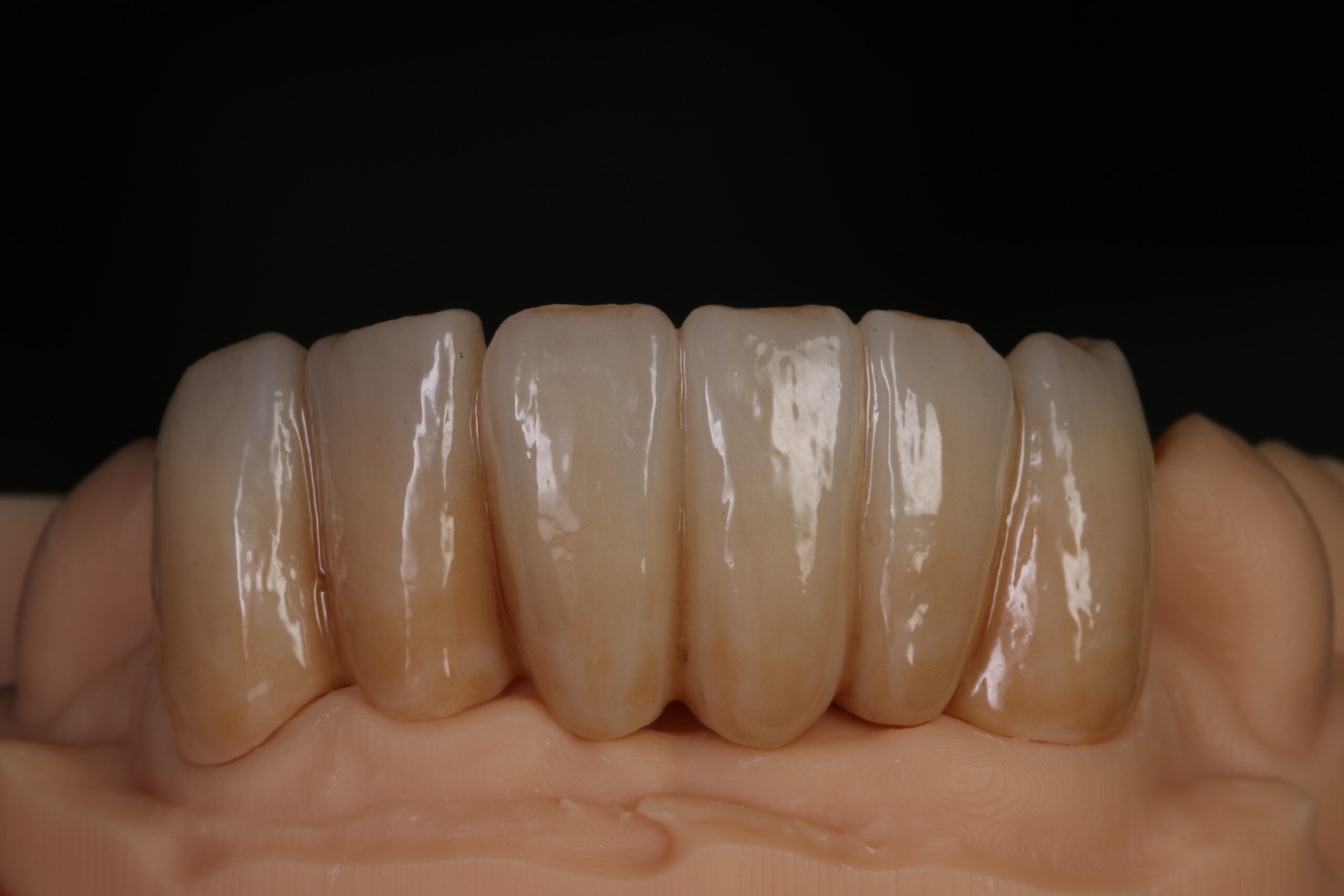

A dental bridge replaces one or more missing teeth by joining a pontic to one or more abutments, and the clinical decision is rarely just “a bridge” — it is which bridge, on which material, with what connector and pontic design. There are four main designs: conventional (fixed-fixed), cantilever, resin-bonded (Maryland), and implant-supported. The right one depends on the condition of the potential abutments, the span, the aesthetic demand, and the occlusal load. This guide works through the types, the bridge-versus-implant decision, material selection, what the evidence shows on longevity, and the design details the lab needs from you.
The four types of dental bridge
Conventional (fixed-fixed) bridge. The pontic is supported by full-coverage retainers on abutments either side. It is the workhorse where both neighbouring teeth are already heavily restored and would benefit from crowns anyway — but it commits sound tooth structure if they are not, which is its main drawback.
Cantilever bridge. The pontic is supported from one side only. Useful where there is a suitable abutment on just one side, it concentrates load, so it is best reserved for shorter spans and lower-load situations with careful occlusal management.
Resin-bonded (Maryland) bridge. A pontic retained by a thin wing bonded to the enamel of the abutment, requiring minimal or no preparation. Modern practice favours a single-wing (cantilever) resin-bonded design over the older two-wing version, which debonded unpredictably. This is the most conservative fixed option and, in the right case, an excellent one.
Implant-supported bridge. The pontic is carried by implants rather than natural teeth, avoiding any load on — or preparation of — the adjacent dentition. This is the natural extension of the same restorative thinking that runs through full-arch implant restorations, scaled to a shorter span.
Bridge or implant?
The honest framing for the patient discussion is that a bridge and an implant solve the same problem differently. An implant preserves the adjacent teeth entirely and stands alone, which is decisive when the neighbours are sound and unrestored. A conventional bridge is quicker, needs no surgery or healing, and is the pragmatic choice when the abutments are already restored or when bone, medical or time factors rule out an implant. The weak point of the conventional bridge is biological: the abutment teeth carry the caries and pulp-vitality risk over the years, which the evidence bears out below. Where you want to conserve sound enamel and avoid that risk, a resin-bonded bridge is often the better middle ground.
Material choice: zirconia or metal-ceramic
For most bridges today the choice is between metal-ceramic (PFM) and zirconia. Metal-ceramic is the long-proven option, but it carries the familiar compromises — porcelain chipping over the metal substructure and a potential grey margin in the aesthetic zone. Zirconia (monolithic or layered) removes the metal, gives better aesthetics, and in full-contour form avoids the veneer-chipping interface. The one design discipline zirconia demands is adequate connector dimensions — the connector is where a ceramic bridge fractures, so it must meet the minimum cross-section for the span. Material choice follows the same logic as any restoration, covered in more depth in our crown material guidance and the implant crown options.
What the evidence shows
Design: pontic and connector
A bridge is made or broken at the design stage, and this is where the prescription matters:
- Abutment preparation — adequate, even reduction and a clear, definable margin on each retainer; parallel path of insertion across the abutments.
- Connector dimensions — specify enough height and width for the material and span (critical for zirconia to resist fracture).
- Pontic design and ridge contact — a modified ridge-lap or ovate pontic for a cleansable, natural emergence; tell the lab the ridge form and whether ovate site development has been done.
- For resin-bonded designs — preserve enamel for bonding and favour a single-retainer cantilever.
Agreeing these with the lab up front — ideally from a clean digital impression — is what produces a bridge that seats and cleanses well rather than one adjusted at the chair.
How Zenith makes your bridges
Crown and bridge is a core Zenith service. Because the founder is a practising dentist, bridge cases are designed around how the restoration has to function and cleanse at the chairside — connector dimensions, pontic form and material chosen for the specific span and site, not a default. We design from your intraoral scan, produce monolithic or layered zirconia and metal-ceramic bridges, and return a digital design preview within 24–48 hours for approval, backed by a 2% remake rate against an 8–12% industry average. You can see our crown and bridge services, and we accept scans from 3Shape, iTero, Medit, DS Core, Carestream and Smilecloud.
If you have a bridge case where the design or material isn’t clear-cut, send it through and we’ll plan it with you.
FAQs
Frequently asked questions
Everything you need to know about working with Zenith Labs.
What are the types of dental bridge?
There are four: conventional (fixed-fixed, crowns on abutments either side), cantilever (supported from one side), resin-bonded or Maryland (a wing bonded to enamel with minimal prep), and implant-supported (carried by implants rather than natural teeth). The choice depends on the abutments, span, aesthetics and load.
Dental bridge or implant — how do I decide?
Choose an implant when the adjacent teeth are sound and unrestored, to preserve them. Choose a conventional bridge when the neighbours are already restored, or when surgery, bone or time rule out an implant. A resin-bonded bridge is the most conservative fixed option where enamel can be preserved.
When is a resin-bonded (Maryland) bridge indicated?
For replacing a single tooth — most predictably an anterior — where the abutment enamel is sound and can be bonded to, and you want to avoid preparing the tooth. A single-wing cantilever design is now preferred, and modern zirconia versions show excellent longevity.³
Zirconia or metal-ceramic for a bridge?
Zirconia gives better aesthetics and avoids metal show and porcelain chipping, provided the connectors meet the minimum dimensions for the span. Metal-ceramic remains a proven option, particularly for longer or higher-load spans. The span, load and aesthetic demand decide.
How long do dental bridges last?
Conventional tooth-supported bridges show around 93.8% survival at five years and roughly 89% at ten years, with most issues being biological problems at the abutments.¹² Modern zirconia resin-bonded bridges have reported around 98% survival at ten years for single anterior units.³
Can I visit your laboratory?
Can a bridge replace a molar?
Yes, but span and load matter. A single posterior pontic between two sound-ish abutments is routine; longer posterior spans concentrate load and favour an implant or a metal-ceramic design with adequate connectors. Assess the abutments and occlusion before committing.
Sources
Pjetursson et al. / NCBI — “A systematic review of the survival and complication rates of fixed partial dentures (FPDs) after at least 5 years — conventional FPDs” — https://www.ncbi.nlm.nih.gov/books/NBK71114/
PubMed — “Comparison of survival and complication rates of tooth-supported fixed dental prostheses (FDPs) and implant-supported FDPs and single crowns” — https://pubmed.ncbi.nlm.nih.gov/17594374/
PubMed — “Ten-year outcome of zirconia ceramic cantilever resin-bonded fixed dental prostheses…” (~98.2% survival) — https://pubmed.ncbi.nlm.nih.gov/28688950/
PMC — “Clinical Performance of CAD/CAM All-Ceramic Tooth-Supported Fixed Dental Prostheses: A Systematic Review and Meta-Analysis” — https://www.ncbi.nlm.nih.gov/pmc/articles/PMC8161295/